


Kenya has become very good at turning almost everything into a political argument. A road becomes a referendum on the president. A railway becomes evidence either of government delivery or government extravagance.
A new hospital is judged according to who commissioned it. A development project in one region is interpreted through the question of which political constituency stands to benefit.
Even before the concrete has dried, the politics surrounding a project can become louder than the economic case for building it.
That may be understandable in a country heading towards another fiercely contested election. But it can also make it difficult to see something important that is happening underneath the political noise: Kenya is gradually changing the physical infrastructure through which its economy operates.
This is the country we don’t see — not because it is hidden, but because we have not yet learned to look at it as anything other than a political event.
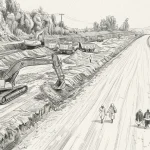
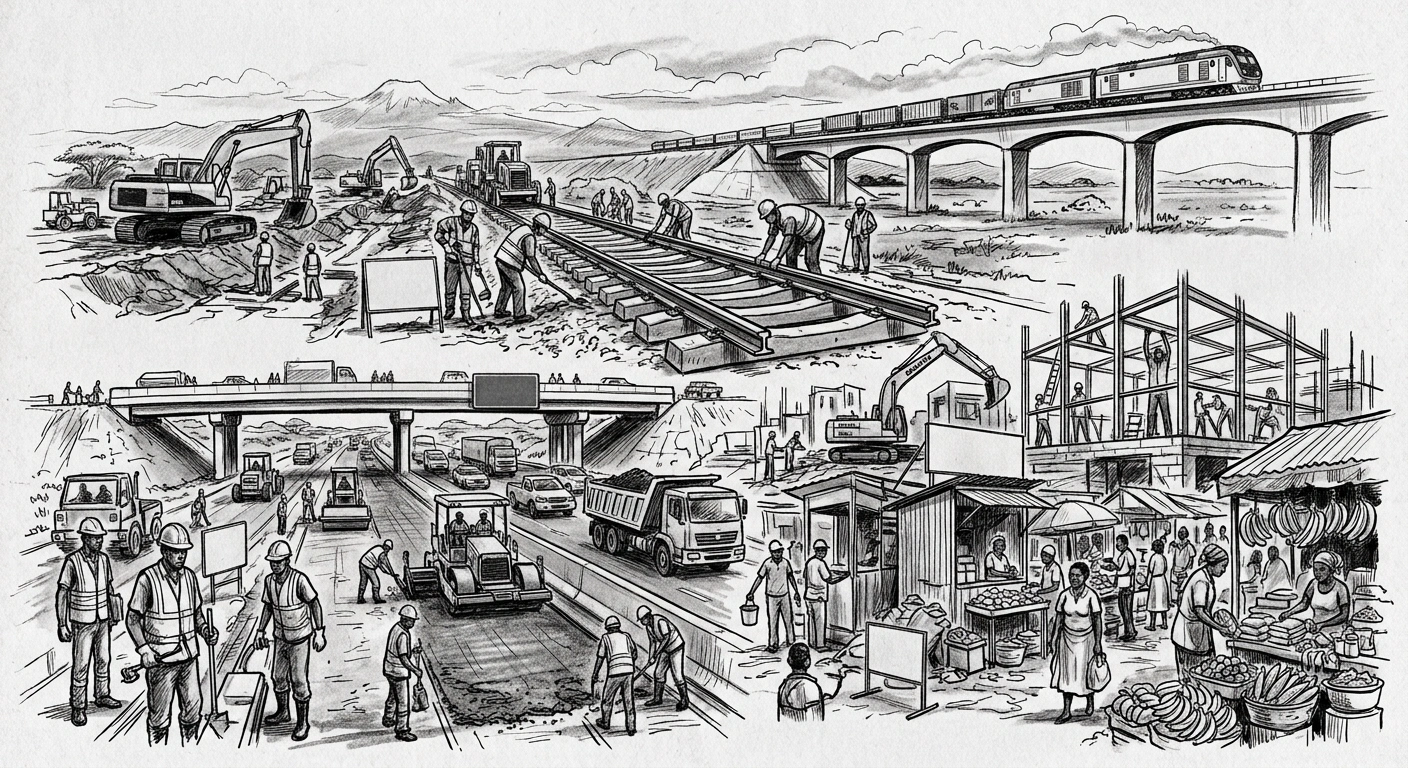
Two projects illustrate the point particularly well. The extension of the Standard Gauge Railway from Naivasha through the Rift Valley to Kisumu and eventually Malaba is intended to push Kenya’s modern railway network deep into Western Kenya and towards the Ugandan border.
The Naivasha–Kisumu section covers 264 kilometres, while the Kisumu–Malaba section adds another 107 kilometres, alongside an 8.69-kilometre branch connecting the railway to Kisumu Port.
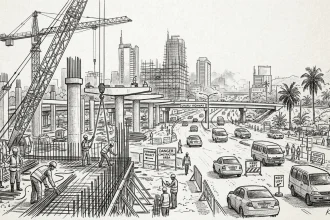
At the same time, the ongoing transformation of the Rironi–Mau Summit road is aimed at one of the country’s most important transport corridors, connecting Nairobi with the Rift Valley, Western Kenya and the wider East African market.
Seen separately, these are construction projects.
Seen together, they are something much bigger: an attempt to reshape the economic geography of Kenya. And that is precisely the part of the story that risks being lost.
We Have Been Here Before
This would not be the first time Kenya built something transformative and then spent years arguing about it instead of using it. The original Mombasa–Nairobi standard gauge railway went through much the same cycle a decade ago.
Its construction was accompanied by relentless debate over cost overruns, procurement, Chinese financing and who stood to benefit politically from its delivery – a debate that consumed far more public attention than the practical question of what the railway would actually do to the cost of moving a container from the coast to the capital.
It took years after commissioning for a serious public conversation to emerge about utilisation rates, cargo volumes, and whether the railway was delivering on its economic promise. By then, the political argument had already been settled in most people’s minds, for or against, along largely partisan lines.
The pattern is worth naming because it suggests something structural rather than accidental. Kenya’s infrastructure debates tend to peak at the moment of announcement and again at the moment of commissioning – precisely the two moments when a project is most photogenic and least understood.
The years in between, when the real economic groundwork is being laid, attract almost no sustained attention. And the years after, when a railway or highway either does or does not deliver the transformation it promised, attract even less.
If that pattern holds for the Naivasha–Kisumu–Malaba line and the Rironi–Mau Summit corridor, Kenya risks spending 2026 and 2027 arguing about groundbreaking ceremonies and procurement contracts, only to seriously ask what either project actually changed well into the next decade – long after that answer might have shaped how the next round of infrastructure gets planned, financed or explained to the public paying for it.
Bigger Than Politics
There is a tendency in Kenyan politics to view development through ownership. Who brought the road? Who funded the railway? Which president launched it? Which region got it? Which politician can claim credit? Those questions matter politically, but they are not necessarily the questions that matter most economically.
A railway does not care which political party won the election. A highway does not distinguish between a Jubilee voter and a Kenya Kwanza voter. A logistics company does not move its cargo according to the political loyalties of the county through which it travels. Infrastructure has a longer life than the political administrations that build it.
The real test is whether these investments make it cheaper, faster and more predictable to move people, agricultural produce, manufactured goods and other cargo. That is where the SGR extension becomes particularly interesting.
Western Kenya is one of the country’s important agricultural and commercial regions, but its economic potential has long been constrained by the cost and reliability of moving goods. The region is not short of production, but efficient connections between production and markets. The railway has the potential to alter that equation.
A farmer, manufacturer or trader does not necessarily need another political speech about development. They need to know whether their goods can reach Kisumu, Nairobi, Mombasa or a neighbouring country more cheaply and reliably.
The Rironi–Mau Summit highway, which is not merely about making the journey from Nairobi to Nakuru comfortable. It sits on the Northern Corridor – an important trade route connecting the Port of Mombasa with Kenya’s hinterland and landlocked economies in East and Central Africa.
Every hour saved on the road, every truck that spends less time in congestion, and every reduction in fuel consumption, vehicle maintenance and cargo delays has an economic value.
These gains are rarely as politically exciting as a groundbreaking ceremony, but over time they can be more consequential.
The Corridor Effect
The most important way to understand these projects may therefore be to stop looking at them as individual pieces of infrastructure. A road changes a road. A railway changes a railway. But a connected road, railway, port, logistics network and marketplace can change an economy.
Consider the geography being created. Mombasa connects Kenya to global shipping, Nairobi remains the financial and commercial centre, and Naivasha is positioned as a logistics and industrial node.
Nakuru sits at the intersection of agricultural production, trade and transport, Kericho is a major agricultural centre, and Kisumu provides access to the Lake Victoria basin.
Western Kenya connects the national economy to Uganda and, through the regional network, to Rwanda, South Sudan and the Democratic Republic of Congo. The infrastructure connecting these places could make their economies less isolated from one another, and that is the potential that deserves attention.
The numbers provide a useful reminder of the scale of the opportunity. According to the Kenya National Bureau of Statistics, the volume of cargo transported by the SGR increased to more than 7.3 million tonnes in 2025, while cargo revenue also rose significantly.
The Port of Mombasa handled more than 45 million tonnes of cargo during the year, with transit cargo accounting for nearly 16 million tonnes.
These are not abstract numbers. They describe the movement of the economy.
When the cost of moving goods falls, markets become larger; when travel becomes more predictable, businesses can plan better; and when a farmer can reach a larger market, production can become more commercially viable.
Infrastructure therefore has a multiplier effect that is difficult to capture in the politics of ribbon-cutting ceremonies. Its achievement may eventually be that people stop talking about the infrastructure because the economic activity it enables has become normal.
Opportunity For Western Kenya
But there is an important caveat. Building a railway into Western Kenya does not automatically transform the region. The infrastructure creates an opportunity, and what happens next depends on what businesses, farmers, counties and national institutions do with it.
The critical question then is whether the railway and road network will help Western Kenya create more value or merely make it easier to transport raw materials out of the region.
If agricultural products simply move faster to processing centres elsewhere, Western Kenya gains from better logistics but may not capture the full economic value of its production. However, if better transport is paired with agro-processing, cold-chain infrastructure, warehouses, manufacturing, financial services and new investment, the effect could be larger.
Kisumu could become more important as a logistics and regional trade centre. Smaller towns along the corridor could attract new businesses.
Farmers could gain access to larger markets. Manufacturers could reconsider locations that previously appeared too far from major transport networks.
This is how infrastructure can change economic geography, but it requires policy beyond the road and railway. It requires counties to prepare land and industrial zones, reliable electricity and water, predictable taxation and regulation, financial institutions willing to finance businesses outside Nairobi, skills, security, and above all, an understanding that transport infrastructure is an enabler, not an economic strategy by itself.
Instead of asking simply whether Ruto has built the railway, Kenya should be asking what Kenya intends to build around the railway.
Danger Of Development as Political Trophies
Governments need to demonstrate that they are delivering while the opposition needs to scrutinise how public money is being spent. Citizens have every right to question costs, procurement, financing arrangements, debt and whether projects offer value for money.
But accountability and cynicism are not the same thing because a project can be expensive and still be economically useful or politically motivated and still produce public value.
A project can be A government can deserve scrutiny while an infrastructure project it delivers deserves an honest assessment. Kenya needs to become better at holding these ideas simultaneously.
The danger of viewing every project exclusively through politics is that the country ends up having two conversations instead of one. The first is about whether the government deserves credit. The second, much more important one, is about whether Kenya is becoming more productive.
The first dominates television, social media and political rallies. The second tends to happen quietly in boardrooms, farms, warehouses, factories and transport yards. Yet it is the second conversation that will determine whether these investments ultimately matter.
Kenya has entered the election season, and there is little reason to expect the political noise to diminish. If anything, every major infrastructure project will increasingly be interpreted as evidence for or against the government seeking another mandate.
But perhaps the country needs to look beyond the political moment. Some of the infrastructure being built today will still be carrying people and goods long after the politicians who inaugurated it have left office. The railway will outlive the campaign posters. The highway will outlive the speeches. The economic corridors will remain long after the political arguments have moved on.
In the pages that follow, we try to look past the ribbon-cuttings and the rallies: at what the corridor could mean for Western Kenya, at how the 2027 election is already shaping the way Kenya talks about development, at what a connected country might actually feel like for the people living along these routes — and at whether Kenya is building the country it thinks it is.