





Kenya left Glasgow with 12 medals from the 2026 Commonwealth Games – three gold, four silver, five bronze – finishing 13th on the final table. It is, on the numbers alone, the country’s weakest Commonwealth showing in more than a decade, ahead of only the 17-medal return from Gold Coast in 2018.
Against Kenya’s own recent history, 21 medals in Birmingham in 2022, 25 in Glasgow, the last time the city hosted in 2014, and a peak of 33 in Delhi in 2010, the instinct is to call this a decline.
That instinct needs a caveat before it becomes a thesis.
Glasgow 2026 was the smallest Commonwealth programme in a generation: ten sports, against eighteen in 2014 and twenty in 2022, after Victoria pulled out as host over budget overruns and Glasgow stepped in as a late replacement with a slimmed-down schedule.
Fewer sports on the programme means fewer chances to medal for every nation. A raw year-on-year medal count, on its own, is not a clean measure of Kenyan sporting decline.
Narrower Base Than Numbers Suggest
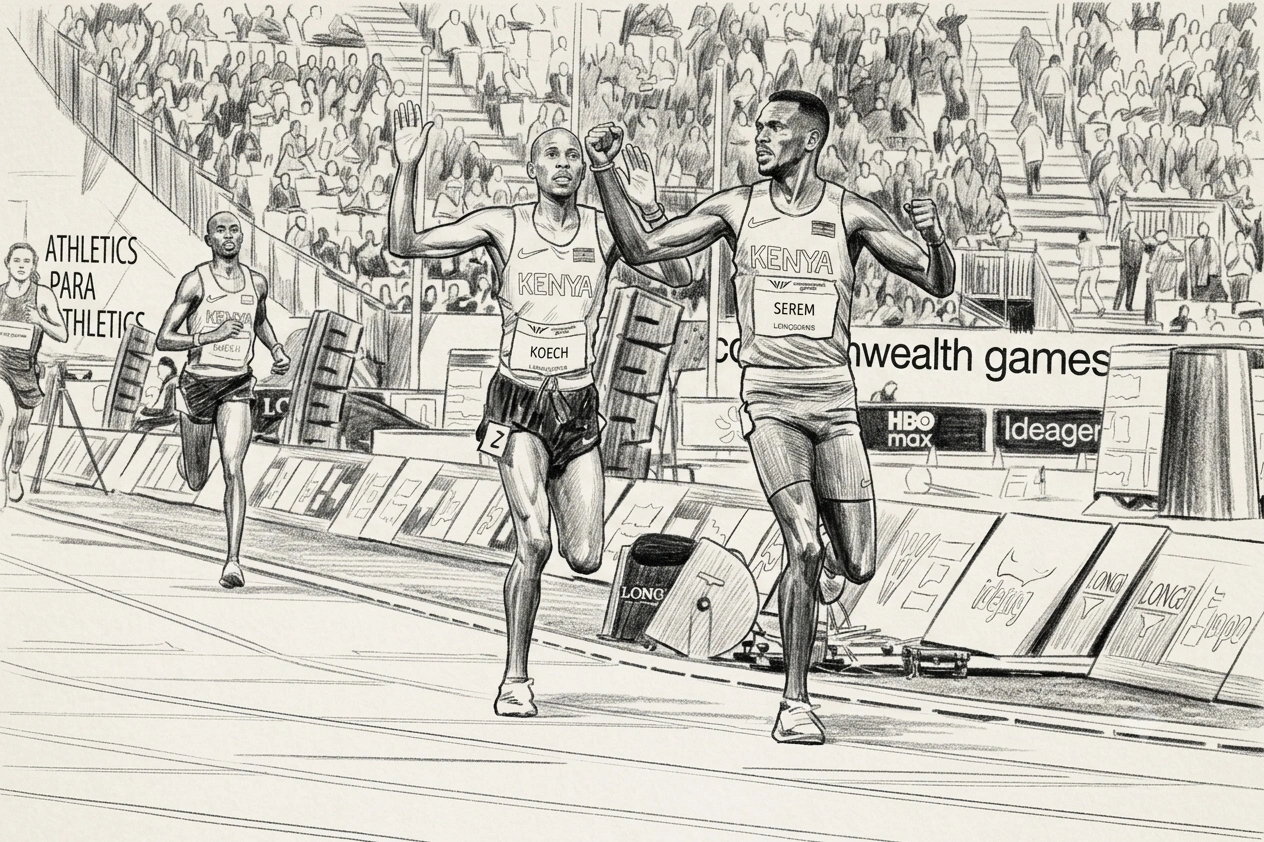
What the count does expose, cleanly, is composition. All three of Kenya’s golds in Glasgow came from distance running. Edmund Serem led an all-Kenyan podium sweep in the men’s 3,000m steeplechase, Faith Cherotich broke the Games record to win the women’s steeplechase, and Mathew Kipchumba Kipsang took the men’s 5,000m.
The two further athletics medals: Simon Kiprop Koech’s steeplechase silver and Diana Wanza’s 10,000m silver, extended the same story. The only medal Kenya won outside athletics was a bronze from weightlifter Joshua Amunga in the men’s 60kg category.
This is not a new pattern; Glasgow sharpened it. At the last Glasgow Games in 2014, twenty-three of Kenya’s twenty-five medals, including all ten golds, were won in athletics.
In Birmingham in 2022, every medal but one, a para-powerlifting bronze, was again athletics. Kenya’s Commonwealth history dates back to 1954 and boasts a total of 258 medals, with athletics and boxing being the primary contributors.
Notably, thirty-four of those medals came from a single event, the 3,000m steeplechase, in which Kenyan athletes went unbeaten in the medal count between 1994 and 2022.
What has thinned out, cycle on cycle, is everything around that core: boxing, rugby sevens, swimming, wrestling, disciplines that used to contribute to the tally alongside track and field, and now rarely do.
What Broader Competitors Look Like
The contrast with a genuine multi-sport programme is instructive. South Africa’s 2014 Glasgow campaign, the last time this city hosted, returned 40 medals across a much wider spread of disciplines, good for seventh overall, nearly double Kenya’s tally from the same Games.
Kenya has never approached that kind of breadth; its Commonwealth identity has always leaned on the highland running belt. But a one-sport medal architecture is a fragile one.
It leaves the country’s entire Commonwealth standing exposed to the form, health and succession of a small pool of distance athletes, and to whatever events happen to survive the next round of programme cuts.
Government incentives for this year’s Games were, notably, athletics-shaped in their scale even if not in their design. The Sports Principal Secretary, Elijah Mwangi, announced increased medal bonuses ahead of Glasgow, gold medallists earning Ksh 2.5 million, up from Ksh 500,000 in 2022, with silver and bronze payouts also roughly quintupling.
Team Kenya’s delegation itself was smaller this cycle; 93 athletes in Glasgow, down from 123 competing across 17 sports in Birmingham in 2022, a contraction that tracks the smaller programme but may also reflect fewer disciplines in which Kenya fielded competitive squads at all.
The Question For The Next Cycle
None of this diminishes what Serem, Cherotich, Kipsang, Koech, Wanza and Amunga did in Glasgow. Three golds and a Games record are a serious return by any standard, and the steeplechase sweep in particular extended a Kenyan stranglehold on that event that is now three decades unbroken.
But a national sporting programme that produces gold in one race after another while returning almost nothing from ten other sports on the card is not simply having a strong distance-running year. It is a signal about where investment, coaching and competitive pathways in Kenyan sport actually sit, and where they don’t.
As Kenya looks toward the next Commonwealth cycle and the Los Angeles Olympics beyond it, the open question is not whether the country can keep producing world-class distance runners, but whether it is willing to build anything resembling a second and third pillar underneath them before the next slimmed-down Games makes the dependency even harder to miss.