


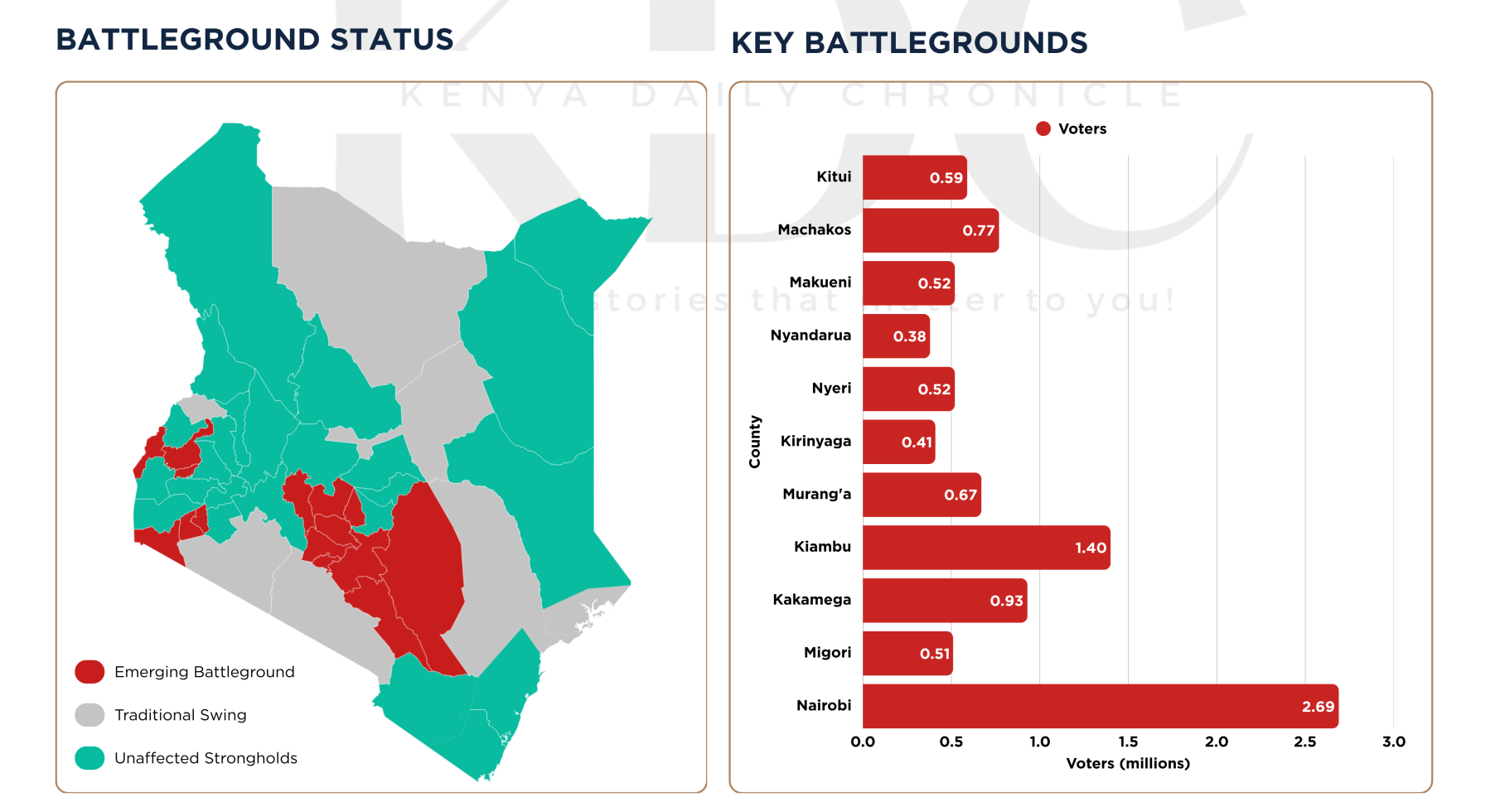
For much of Kenya’s multiparty history, presidential elections have followed a remarkably predictable script. The arithmetic rarely changed. Candidates assembled regional and ethnic voting blocs, secured their traditional strongholds, competed over a handful of swing counties and waited for the numbers to add themselves up. By the time campaigns officially began, most of the electoral map had already been coloured in.
That was certainly true in 2022. William Ruto’s victory rested on one of the clearest coalition equations in recent political history. Mount Kenya and the North Rift supplied roughly two-thirds of his total vote, while Raila Odinga dominated Nyanza, much of Western Kenya and the Coast.
Only a small cluster of counties, including Narok, Kajiado, Marsabit, Isiolo and Trans Nzoia, remained genuinely competitive. Everything else behaved almost exactly as political tradition suggested it would. Four years later, that electoral map no longer exists.
What has emerged instead is a far more complicated political landscape where historical loyalties are colliding with internal party fractures, demographic change and rapid urbanisation.
The result is that Kenya heads towards the 2027 General Election with three electoral maps layered on top of one another: the traditional map of ethnic alliances, a new map of fractured political loyalties, and a rapidly evolving demographic map driven by population growth and voter registration. None of them, on its own, is sufficient to explain where State House will be won or lost.
End of Safe Strongholds
The first and perhaps most dramatic transformation has occurred in Mount Kenya. For nearly two decades, the region has functioned as a remarkably disciplined voting bloc.
Once political consensus emerged, counties from Kiambu to Nyeri, Murang’a, Kirinyaga and Nyandarua generally moved together. That unity delivered overwhelming margins for Uhuru Kenyatta in 2013 and 2017 before transferring almost wholesale to William Ruto in 2022, when some counties handed him more than 80 per cent of the presidential vote.
Rigathi Gachagua’s impeachment as Deputy President in October 2024 fundamentally altered the region’s political dynamics. Rather than retreating quietly, Gachagua transformed himself into the focal point of opposition within the very region that had powered Ruto’s rise.
Through his Democracy for the Citizens Party (DCP), endorsements of rival candidates and an aggressive political campaign centred on Wamunyoro, he has recast the 2022 vote not as a triumph but as a mistake that Mount Kenya must now correct.
President Ruto, meanwhile, has responded with repeated development tours, infrastructure promises and direct appeals to voters, insisting that his relationship with the region extends beyond his former deputy.
Whether Gachagua ultimately succeeds is almost secondary. The political consequences are already evident: counties once regarded as safely within Ruto’s column have become genuine battlegrounds.
But the second disruption to Kenya’s electoral arithmetic came from an entirely different direction. Raila Odinga’s death in October 2025 removed not simply an opposition candidate but the central figure around whom one of Kenya’s most durable political coalitions had been organised for three decades.
ODM suddenly found itself without the individual capable of balancing competing regional interests, managing internal disagreements and speaking authoritatively for the wider opposition.
Although the party has formally maintained its support for the broad-based arrangement with President Ruto, it has deliberately postponed making a definitive decision on its 2027 presidential direction.
That uncertainty leaves an unprecedented political vacuum across Nyanza and parts of Western Kenya. Counties that routinely delivered overwhelming margins for Raila Odinga now face a question they have never previously had to answer: if Raila is absent from the ballot, where do those votes go?
They may remain within ODM. They may fragment among regional leaders. They may reluctantly support President Ruto. Or turnout itself may decline.
None of those outcomes can yet be predicted with confidence, but the assumption that Nyanza automatically belongs to one coalition has become far less certain than it once appeared.
Where the Votes Are Growing
If these political realignments represent one layer of Kenya’s changing electoral map, demographics represent another. The IEBC’s Enhanced Continuous Voter Registration exercise added approximately 2.35 million new voters ahead of the 2027 elections.
On paper, that appears to be a routine administrative statistic. In practice, however, the geographical distribution of those new registrations reveals where political influence is increasingly concentrated.
Rather than being spread evenly across the country, much of the growth is occurring inside counties that already possess enormous electoral weight. Nairobi alone registered almost 277,000 new voters during the exercise, while Kiambu added more than 128,000.
Nyeri and Murang’a also recorded substantial increases alongside high levels of voter transfers and changes of registration, indicators that political mobilisation is intensifying in precisely those regions now experiencing heightened competition.
This is significant because counties are no longer equal units in presidential politics. Historically, Nairobi has reflected national political coalitions while remaining ethnically mixed enough to resist easy categorisation. Today, it is evolving into something even more distinctive.
It contains the country’s largest concentration of young voters, professionals, university students, informal workers and internal migrants. These voters continue to care about political identity, but increasingly they are also responding to issues such as taxation, unemployment, housing affordability, transport, healthcare and the cost of living.
That does not necessarily mean Kenya is abandoning identity politics. Coalition-building, local political networks and ethnic mobilisation remain central features of presidential campaigns. But they are now competing with governance, economic performance and generational concerns in ways that previous elections rarely required.
Beyond Nairobi and Mount Kenya lies another layer of competitive territory. Counties such as Kajiado, Narok, Marsabit and Trans Nzoia were already closely contested in 2022 and remain highly competitive today. At the same time, expanding urban centres including Machakos, Mombasa, Kisii, Bungoma, Busia and Vihiga are steadily increasing both their electoral weight and their political unpredictability.
These are not necessarily the counties dominating today’s headlines, but they are steadily becoming more important as population growth and urbanisation reshape Kenya’s voter distribution.
The Youth Variable
It is tempting to interpret these demographic shifts as evidence that Kenya is finally transitioning towards issue-based politics. Certainly, there are reasons to believe this may be happening. Many of the fastest-growing counties are also among the country’s most urbanised.
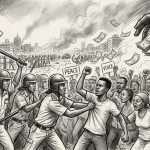
Younger voters increasingly cite employment, taxation, governance, housing and economic opportunity among their principal concerns. The anti-Finance Bill protests of 2024, led by the youth, demonstrated a willingness among younger Kenyans to organise around shared national grievances rather than traditional political identities. Yet caution is warranted.
Registration does not automatically translate into turnout, which does not necessarily produce coherent voting blocs. And demographic change alone does not erase years of political socialisation.
The implication for presidential campaigns is profound. Traditional strategy emphasised maximising turnout inside loyal ethnic strongholds before making selective investments in swing counties.
The emerging map demands something different. Candidates must now defend regions they previously assumed were secure while simultaneously competing for rapidly expanding urban electorates whose political priorities are less fixed than those of previous generations.
Ultimately, the defining question of 2027 is no longer whether William Ruto can repeat the coalition that elected him in 2022. That coalition has already changed.
The more important question is whether the political fragmentation in Mount Kenya, the leadership vacuum within ODM and the country’s shifting demographic centre reinforce one another or cancel each other out.
For the first time in many election cycles, Kenya is approaching a presidential contest where victory may depend less on assembling the familiar ethnic coalition than on understanding how three different electoral maps intersect.
The politicians who continue campaigning as though the country still resembles the Kenya of 2022 risk fighting the next election with the arithmetic of the last one.