


When it comes to infrastructure, there is a familiar ritual in Kenyan politics whenever a new highway opens, a railway is launched, an airport expansion begins, or a bridge is commissioned.
Supporters of former Prime Minister Raila Odinga are quick to claim it as part of his legacy, while critics are equally quick to dismiss those claims as political mythology. Yet, months later, another road, another port or another bypass will spark the same debate all over again.
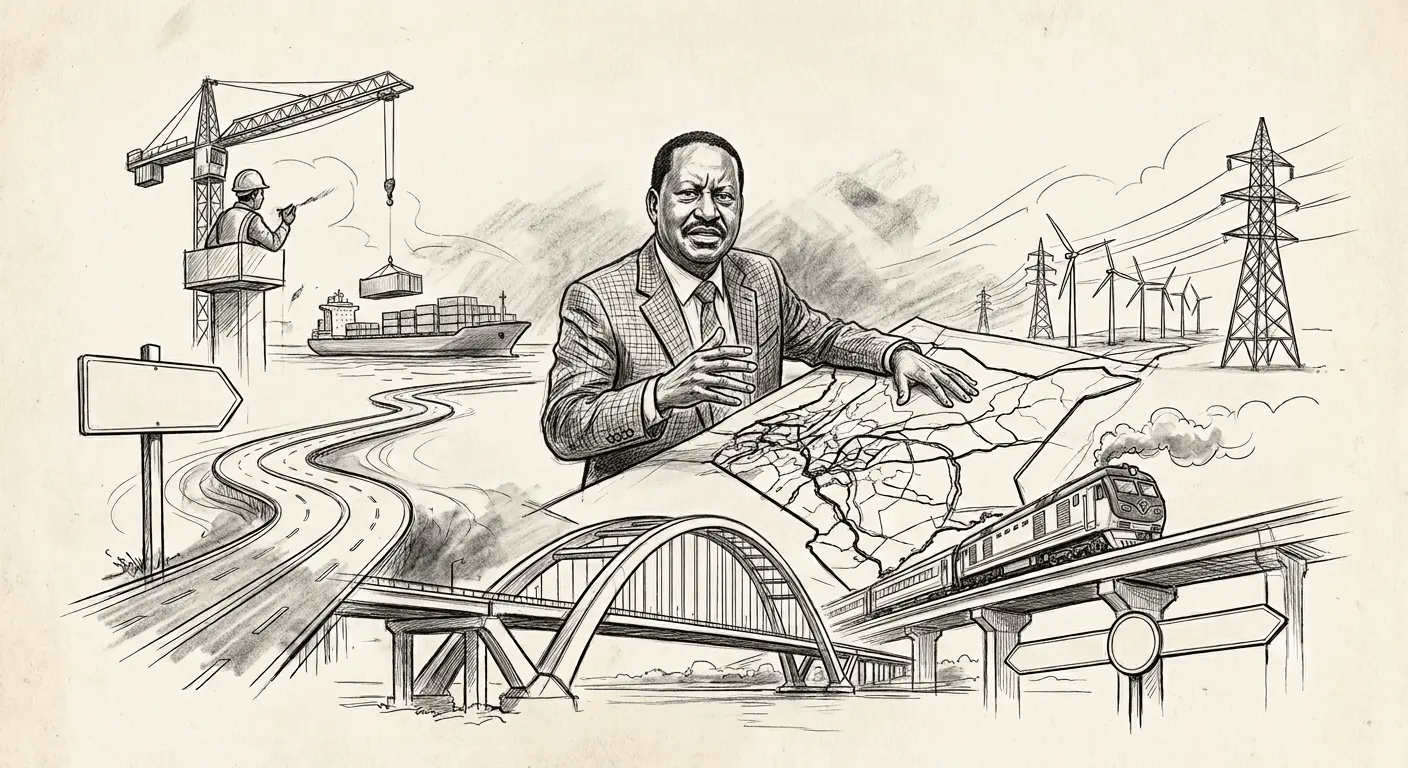
Supporters point to the Thika Superhighway, the Southern and Northern bypasses, the expansion of the Port of Mombasa, LAPSSET, Konza Technopolis and even the Standard Gauge Railway as evidence of Raila Odinga’s transformative vision.
His critics often push back, arguing that many of these projects were financed, built and commissioned by governments in which he either played a limited role or no role at all. Yet the remarkable thing is not that the argument exists, but that it never really goes away.
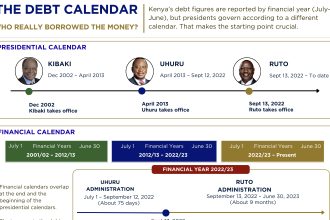
Successive presidents, from Mwai Kibaki to Uhuru Kenyatta and now William Ruto, have found themselves governing in the shadow of Raila’s infrastructure reputation.
Even projects initiated years after he left the executive office are routinely linked to him, sometimes by supporters, sometimes by politicians seeking continuity, and occasionally even by his political rivals.
How did one politician become synonymous with Kenya’s physical transformation? The answer lies not in who built every road, but in who came to embody the idea of building itself.
Minister Who Changed the Conversation
When Raila Odinga was appointed Minister for Roads, Public Works and Housing in 2003, Kenya’s infrastructure was in poor condition. Only about 10 per cent of Kenya’s roughly 60,000 kilometres of roads were paved, following years of stagnation under the outgoing Moi government.
His ministry launched a National Roads Improvement Programme, a three-year, Ksh20 billion initiative targeting 3,000 kilometres of Class A and B roads, and had contracted 24 projects covering more than 1,200 kilometres by early 2005.
He resurrected the Thika Superhighway from a dormant early-1990s blueprint, secured financing, and authorised demolitions of encroaching commercial structures to clear the route, a decision that drew accusations of ethnic targeting at the time and that he defended as a necessary “sacrifice for modernisation.
The highway itself would only be completed years later under President Kibaki. But the project became closely associated with Raila because he was the politician who transformed it from an idea into a government priority. That distinction would define much of his later reputation.
One reason Raila continues receiving credit for projects completed by later administrations is that infrastructure simply does not fit within electoral cycles.
Major highways, railways and ports take years to conceptualise, finance, design and construct. The politician who launches a feasibility study is rarely the one who commissions the completed project.
This creates overlapping political ownership, and the Standard Gauge Railway illustrates the point. Its construction, financing and commissioning largely occurred under President Uhuru Kenyatta.
Yet discussions around modernising Kenya’s railway system had gained momentum during the Grand Coalition Government in which Raila served as Prime Minister.
Supporters, therefore, argue that he helped lay the groundwork. Critics counter that groundwork is not the same as construction. Both arguments contain elements of truth, as infrastructure is cumulative and every administration inherits projects at different stages of completion and passes others to its successor.
The temptation is to assign ownership to individuals when, in reality, most major projects are institutional achievements stretching across multiple governments.
The Grand Coalition Legacy
Between 2008 and 2013, Raila occupied a position unlike any previous Kenyan politician. As Prime Minister in the Grand Coalition Government, he became one of the administration’s principal advocates for large-scale public investment.
Road expansion accelerated, port development gathered pace, urban transport planning received renewed attention, Konza Technopolis entered the national development agenda, and Regional transport corridors became central to Kenya’s Vision 2030 ambitions.
Although President Kibaki remained Head of State and retained ultimate executive authority, Raila became the administration’s most visible political salesman for infrastructure-led growth. Cabinet decisions may be collective, but public memory often attaches them to the politician most closely identified with the idea. That is precisely what happened.
Over time, Raila ceased to represent only the projects he directly supervised. He came to symbolise a broader philosophy of development.
Unlike many politicians whose public messaging revolved around welfare programmes or political reform, Raila consistently spoke the language of roads, ports, railways, industrial parks and regional integration.
Infrastructure became central to his political identity, and his supporters reinforced that narrative with every completed highway. Opponents, often unintentionally, strengthened it further by arguing over the extent of his contribution. The result is that Raila’s name became attached not merely to projects but to the very concept of modernisation.
Why Every Government Invokes Him
Successive administrations have discovered that infrastructure is one of the few areas where political continuity carries more benefits than costs. Roads do not belong to political parties, ports outlive governments, and railways survive generations of leaders.
Governments often prefer presenting themselves as continuing a national development journey rather than starting entirely new ones.
Raila’s reputation makes him useful in that narrative, and his supporters interpret new projects as proof that his vision is being realised. Governments can describe infrastructure expansion as building on foundations laid decades earlier.
Even critics rarely dismiss his contribution entirely because doing so would require discounting one of Kenya’s most visible periods of public investment.
None of this means every infrastructure claim attached to Raila is historically accurate. Some projects frequently attributed to him were conceived before he entered government.
Others were financed, procured and completed entirely under later administrations. Still others evolved so dramatically during implementation that they bear little resemblance to their original proposals.
Equally, it would be misleading to suggest he deserves no credit simply because others completed the work. The honest historical record lies somewhere between hero worship and revisionism.
Raila neither built every road in Kenya nor merely watched others do so. He was one of the architects of an era that placed infrastructure at the centre of national development policy.
The Legacy That Outgrew the Man
The clearest measure of Raila Odinga’s infrastructure legacy is not the number of roads he personally initiated. It is the fact that Kenyans instinctively invoke his name whenever a major public works project is announced. Few politicians retain that kind of association long after leaving executive office. It reflects not simply memory but branding.
Raila successfully positioned himself as a champion of modern infrastructure at a moment when Kenya was beginning one of the most ambitious periods of public investment in its history.
Whether subsequent governments expanded, accelerated or completed the projects is an important historical question. But it does not erase the political reality. In Kenya today, infrastructure has become part of Raila Odinga’s identity.