



Four years into the William Ruto presidency, the temptation is to measure the administration against the expectations created by the 2022 campaign and conclude that the Bottom-Up Economic Transformation agenda either succeeded or failed. Neither conclusion captures what has happened.
The more interesting assessment is that Ruto has been considerably more effective at implementing programmes within the direct control of government than at transforming the underlying economic conditions that originally made his political message so powerful.
That distinction matters because the Ruto presidency has gradually changed its own definition of success. In 2022, the administration sold Kenyans a different economic philosophy, one in which the ordinary citizen would move from the margins of the economy to its centre.
By 2026, the argument has become much more concrete: houses have been built, roads rehabilitated, markets constructed, electricity connections made, farmers supported, and government services digitised. The President’s repeated challenge to his opponents to produce their own scorecard is therefore not without substance. There is a record to defend.
The problem for his critics is that dismissing that record simply because it does not amount to the transformation promised in 2022 understates the extent to which Kenya has changed during his tenure.
Why Delivery Clustered Where It Did
The pattern across this record is not random. Every credible win below sits in a domain where the state controls the money, the contractor and the timeline directly: a construction programme funded by a dedicated levy, a subsidy disbursed through a known list of farmers, a fibre contract awarded and built out.
These are execution problems, and execution is the thing this administration has shown it can do.
The domains where the record gets harder – household income, private investment, job quality – are domains where government can fund or facilitate but cannot dictate the outcome.
That fault line runs through this entire audit, and it cuts in an interesting direction. Elsewhere in this issue, The Weekly Chronicle’s recurring finding is that Kenya’s credible gains cluster where state intervention was narrowest.
Here the opposite is true – the wins are concentrated where the state intervened most directly. Worth holding both findings up against each other rather than resolving the tension for the reader.
The Strength Of Delivery
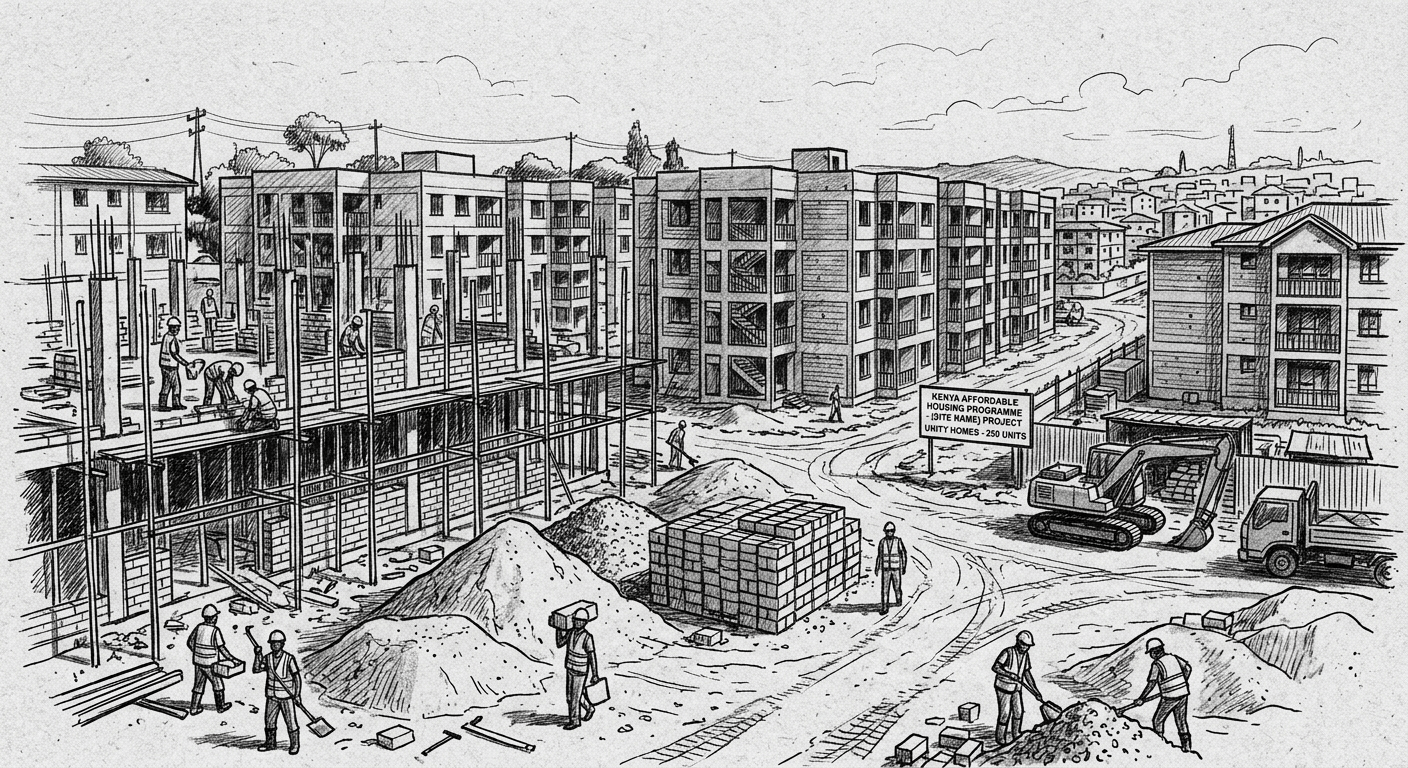
The clearest successes are found in areas where the state can directly mobilise money, institutions and contractors. Affordable housing is the most obvious example.
The programme has generated controversy over the levy used to finance it, survived a significant legal challenge and attracted legitimate questions about affordability and access, but it has nonetheless moved beyond the realm of political rhetoric. More than 230,000 housing units reported as completed or under construction by mid-2026.
That figure should not be confused with full delivery of the original manifesto promise, which envisioned 250,000 units annually, but it demonstrates something important: the administration has managed to turn housing into a functioning national construction programme rather than another recurring campaign pledge.
The same logic applies to infrastructure. Markets, roads, electricity connections and public facilities are tangible interventions, particularly in parts of the country where citizens have long experienced government primarily through taxation rather than visible public investment.
Road rehabilitation and infrastructure projects have become central features of Ruto’s political tours.
This is politically significant because governments are often judged through what citizens can physically see. A completed market, an electrified home or a new road may not transform household incomes overnight, but it changes the relationship between the citizen and the state in a way that a policy document cannot.
Agriculture: The Strongest Case
If there is one sector where the administration can make a particularly credible argument for intervention, it is agriculture.
The fertiliser subsidy programme has reduced the cost of a critical farm input, while reforms in coffee have attempted to address longstanding weaknesses in how farmers are paid and how the value chain operates.
The Weekly Chronicle’s earlier scorecard recorded coffee farmgate prices rising to about Sh158 per kilogramme from roughly Sh50–60, while maize production rose from 61.7 million 50-kilogramme bags to 85.7 million bags.
The numbers do not prove that every farmer is better off, nor do they establish that every increase is attributable exclusively to government policy. Commodity prices, weather, global markets and private-sector behaviour matter. But they do demonstrate that agricultural policy under Ruto has not been merely rhetorical.
The administration has also pursued direct farmer payment mechanisms, coffee-sector legislation and sugar-sector restructuring, attempting to address institutional problems that have survived several governments.
That is perhaps the more important point. Agriculture has historically been a sector in which Kenyan governments announce interventions without fundamentally altering the machinery through which farmers interact with markets. Ruto’s record is incomplete, but there is evidence of an attempt to change that machinery.
Quiet Revolution In Government
The least politically dramatic achievement may ultimately be one of the most consequential: the continuing digitisation of government.
The migration of services to eCitizen, expansion of digital identity systems, growth in digital employment initiatives and improvements in online public-service access do not generate the same political excitement as a road launch, but they represent a structural change in how citizens interact with the state.
The administration has also made artificial intelligence and digital employment part of its national policy conversation, while the Ajira programme has trained 391,000 people. There is an important caveat: training people for digital work is not the same as creating a sustainable job for each of them.
Yet the direction is significant because Kenya’s future competitiveness will increasingly depend on whether it can convert its relatively strong digital infrastructure and youthful population into productive economic participation.
Ruto has also taken Kenya’s digital policy conversation beyond domestic administration. At the G7 summit at Évian, Kenya pushed for AI safeguards for African children and safety measures in Kiswahili and Sheng.
The summit did not produce an immediate financial dividend for Kenya, but it demonstrated a more assertive attempt to shape international technology policy rather than merely consume it.
The Case For Ruto is Therefore Real
The strongest argument for Ruto is not that he has fulfilled the 2022 manifesto. He has not.
It is that he has demonstrated a capacity to implement at scale in several areas where government possesses direct levers, and that some of those interventions are producing measurable results.
The administration has built things, digitised things, connected people, intervened in agriculture and created programmes that did not exist at anything like their current scale four years ago.
This matters but also creates the administration’s biggest problem: once a government makes delivery its principal argument, every unfinished promise becomes more visible.
A housing programme measured against 230,000 units must still be measured against the promised one million.
A digital programme must be measured against the promised 100,000 kilometres of fibre, of which the earlier scorecard recorded only 4,690 kilometres completed. Public Wi-Fi must be measured against the 25,000 promised locations, against 1,563 established.
The Ruto presidency therefore deserves credit for something previous governments have often struggled to demonstrate: implementation. But implementation is only half the test.
The other half is whether what is being implemented changes the lives of the people for whom the transformation was supposedly designed. And that is where the case for Ruto becomes considerably harder.