






William Ruto’s most consequential political loss may not be a county, a coalition or even a traditional ethnic voting bloc. It may be a generation.
In 2022, Ruto understood something the political establishment had struggled to articulate: a large, assertive generation of young Kenyans did not see itself in the old political bargain — educated but underemployed, connected but excluded, impatient with a system that recycled the same elites.
The “hustler” narrative spoke directly to that frustration, built around an outsider identity as much as an economic one. That was the opportunity and also the beginning of the expectation.
Four years later, the relationship is nearly inverted. The young Kenyans who once saw Ruto as a vehicle for disrupting the old order became the core of the movement that disrupted his government in June 2024.
They did not reject one tax proposal. They rejected what they had come to believe the presidency was. Winning them back now requires more than another youth programme — it requires rebuilding a proposition that has already been tested and found wanting.
The rupture did not start with the 2024 Finance Bill, though the Bill gave it a common language.
Ruto inherited high debt and inflation, and his response leaned on raising revenue and broadening the tax base — defensible fiscal logic.
But to many young Kenyans, it sounded like a reversal: a government that campaigned on making the economy work for the bottom now appeared to be asking the bottom to finance the state. The question was personal, not ideological: What am I getting in return?
That question grew harder to answer as the cost of living, unemployment and corruption stayed prominent. A 2024 Infotrak survey found strong majority support among young respondents for the protests, citing cost of living, desire for change and accountability as the leading reasons.
The Finance Bill was the trigger. The underlying problem — a political system that had changed hands without changing character — was larger.
June 2024 Changed The Relationship
The 2024 demonstrations were leaderless and decentralised: no presidential candidate directing them, no party structuring them, no ethnic kingpin claiming them.
Young Kenyans organised through X, TikTok and WhatsApp, documented police conduct in real time, and built their own political vocabulary — revealing a political infrastructure the state could not route around.
Withdrawing the Bill calmed the immediate crisis but did not restore the relationship, because the protest had already outgrown the legislation that triggered it. The demand had broadened to accountability, governance, jobs and respect for citizens — the protest stopped being about a bill and became about the credibility of the state.
The Problem Is No Longer Simply Economic
A young person can tolerate economic difficulty if the system feels fair and sacrifice feels shared. What’s harder to tolerate is economic pressure combined with political distrust — and that combination is what 2024 crystallised.
The generation did not simply say we are poor. It said: we can see how government works, who benefits, what you promised, and when those things don’t match. That is a harder constituency to persuade than a hungry one.
Multiple surveys have found unemployment, corruption and cost of living still dominating youth concerns two years on, alongside evidence that youth political engagement had evolved into decentralised activism rather than disappeared.
“Gen Z” is not a single bloc — it is divided by class, geography and outlook, and government supporters exist within it. What increasingly unites its sceptical core is not a candidate. It is scepticism itself — harder to mobilise, and harder for a government to overcome.
Old Language No Longer Works
The vocabulary that won 2022 is weaker now because voters have had four years to test it. The “hustler” was an outsider fighting a system.
The President is now the system — an unavoidable transformation, but one Ruto’s original appeal was built to resist.
The post-2024 broadening of government to incorporate old political formations reinforced, among young activists, a sense that politics had reverted to elite bargaining rather than being reformed.
Young voters do not necessarily oppose coalition-building; what they oppose is being told politics has changed when the political class visibly has not.
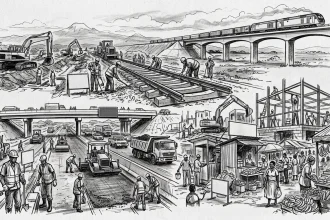
The same gap applies to communication. Ruto’s presidency is fluent in numbers — roads, houses, fertiliser, SHA registrations, connections, digital jobs.
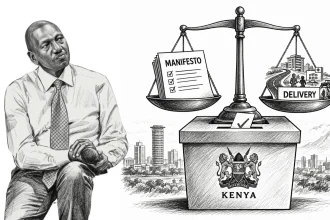
Some of those numbers represent genuine achievement, as The Weekly Chronicle’s wider scorecard shows. But delivery language doesn’t answer the question younger voters are actually asking, which is whether the system is becoming fairer. A road answers one question. Trust requires something else.
Getting Them Back Harder Than Winning Them
More jobs, more digital programmes, more credit access — all would help. None alone solves the political problem, for four reasons.
First, the generation has learned to distinguish a programme from an outcome. 391,000 Ajira trainees and the Hustler Fund’s 21.87 million enrolled borrowers are real numbers, but young people can reasonably ask how many moved from training into stable income, or from borrowing into a functioning business. Training is not employment. Credit access is not wealth.
Second, expectations have changed. A generation that watched 2024 unfold on a smartphone compares what leaders say in one place against what happens elsewhere, almost instantly. That makes spin harder, not impossible.
Third, there is memory. Governments assume political anger has a short shelf life; this generation has shown otherwise — the protest anniversaries have themselves become political moments, evidence the grievance hasn’t faded even as street mobilisation has changed shape.
Fourth, and hardest: Ruto is no longer competing only against politicians. He is competing against cynicism, which does not concede ground the way an opponent does.
It May Not Want A Saviour
The 2024 movement was cross-ethnic, decentralised and issue-based — legitimacy built from collective action rather than a recognised hierarchy, a form of accountability exercised outside electoral structures altogether.
That may be the more important signal heading into 2027. Ruto’s strategy remains fundamentally electoral — delivery, coalitions, alliances. The Gen Z political instinct is different: less concerned with who owns the machine than with whether it works.
That doesn’t mean this generation will abstain from ethnicity, region or family loyalty at the ballot box. It means the old methods of winning its trust are less reliable than they were in 2022. A rally generates a crowd. A hashtag generates impressions. Neither generates trust.
According to the most recent Infotrak poll, Ruto is still the most popular among those aged 18 to 35. Among the 18- to 26-year-olds, he leads with 28 per cent, followed by Edwin Sifuna at 20 per cent. In this cohort, 4 per cent are undecided.
Among those aged 27 to 35 years, Ruto gets a 31 per cent rating, followed by Sifuna at 14 per cent, with the undecided at 21 per cent. Even when stretched further, he leads among the 26 to 45 years cohort with 32 per cent, followed by Fred Matiang’i with 14 per cent, while the undecided here are 20 per cent.
Road Back Runs Through Credibility
None of this is necessarily permanent. Governments recover support when conditions improve, and institutions visibly deliver. But the route back does not run through another slogan.
It runs through jobs young people can actually obtain, not merely programmes that train them; taxation defended by visible returns rather than assertion; accountability that extends beyond compensation and statements of regret; participation treated as policy input rather than procedure.
Above all, it runs through accepting that this generation is no longer an audience for government messaging — it is a constituency capable of talking back.
The 2022 campaign understood the hunger for inclusion better than its rivals did. The tragedy is that the same generation that responded most enthusiastically became the generation best equipped to measure the distance between promise and experience.