



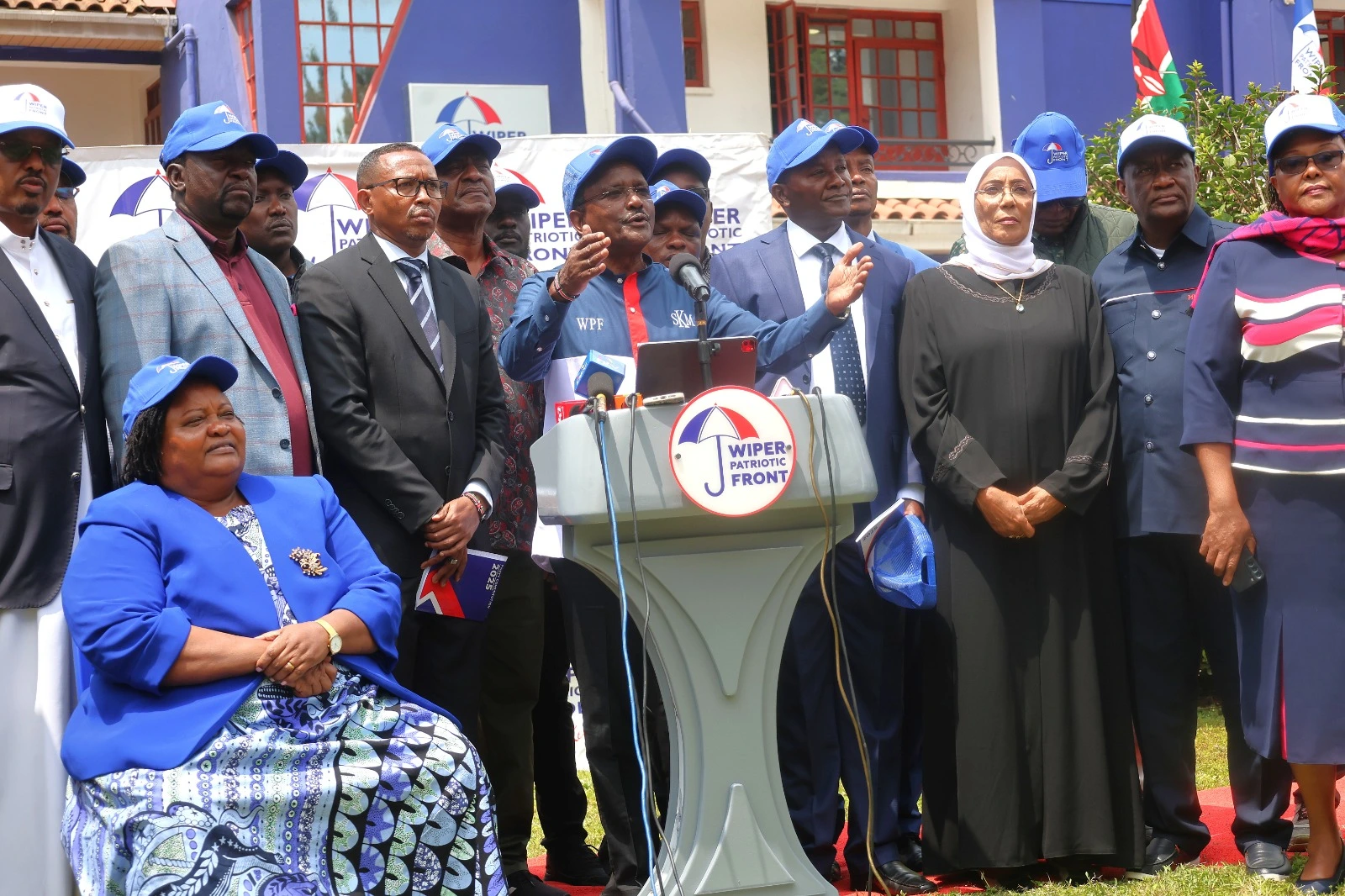
Wiper Leader Kalonzo Musyoka, who has emerged as a frontrunner for the 2027 presidential race, is betting that Kenyans will vote on the cost of the Ruto years, and that a united opposition can turn anger into power.
In a statement on the one year to elections issued on Monday, Kalonzo did not want Kenyans looking forward, stating that the first question of 2027 should not be what Ruto plans to do next, but what happened to the promises that brought him to power in the first place.
Kalonzo is emerging as one of the most plausible figures around whom an anti-Ruto coalition could organise, and his opening statement suggests that he understands the central challenge of an opposition campaign: anger against an incumbent is not, by itself, an alternative government.
His statement, therefore, does two things simultaneously. It attacks Ruto’s record with unusually direct language, while beginning to construct the policy and institutional alternative around which Kalonzo wants the opposition to rally.
Kalonzo’s Scorecard on Ruto
The first part is unmistakably a referendum argument. Kalonzo takes aim at virtually every major pillar of the Ruto administration’s political proposition: Bottom-Up economics, healthcare reform, education, taxation, employment and the cost of living.
His indictment of the Social Health Authority is particularly stark. Where Ruto presents the transition from NHIF to SHA as one of the defining reforms of his administration, Kalonzo portrays it as a system that has left Kenyans “paying more for less”.
The contrast is politically useful because healthcare is one of the areas where the government’s reform story is most vulnerable to the difference between policy design and lived experience.
Ruto can point to millions of SHA registrations and thousands of contracted facilities. Kalonzo’s counter is essentially that registration is not the same thing as healthcare.
The same logic runs through his criticism of education. The government can point to teachers recruited, classrooms built, and TVET enrolment expanded.
Kalonzo wants the voter to think instead about schools struggling with funding, teachers waiting for pay and families confronting a university funding system they perceive as unpredictable.
Then comes the most potent issue of all: the household economy. Kalonzo’s argument is that Kenyans were promised relief but instead received a heavier tax burden, while food, fuel, transport and rent remain expensive, and wages have failed to keep pace.
This is where the opposition’s campaign could become most consequential. The government has a macroeconomic story, but Kalonzo is attempting to construct a household economic story.
An economy can grow at around five per cent while many households continue to feel poorer. Government revenue can increase while taxpayers feel squeezed. A reform can be administratively ambitious while producing an experience that citizens consider worse than what came before.
The 2027 election will partly be a battle over which of these realities becomes the dominant narrative.
But Kalonzo’s statement is more interesting than a conventional opposition attack because he recognises that “Ruto must go” is not a governing programme.
His 13-point “People’s Budget” attempts to answer the question that has repeatedly bedevilled Kenyan opposition politics: what happens after the incumbent is defeated?
The agenda begins with universal healthcare and free, quality education and moves through living wages and employment, food security, tax justice, constitutionalism, devolution, youth and women’s empowerment, infrastructure and housing, social protection, climate justice, anti-corruption and national unity.
It is broad by design, but also a direct attempt to reclaim some of the political territory that Ruto occupied in 2022.
The language of the carpenter, mama mboga and boda boda rider was central to the original Bottom-Up proposition. Kalonzo is effectively arguing that the political constituency Ruto claimed to represent has been betrayed by the government that promised to empower it.
That is a much smarter proposition than simply returning to the opposition’s familiar language of elite-versus-people politics.
His most aggressive attack comes when he describes the succession of government visions, from Hustler Nation to Bottom-Up, the Singapore Dream and now Vision 2060, as evidence of rebranding rather than delivery.
The phrase “you cannot rename your way out of a broken promise” captures the heart of his argument and is also likely to become one of the defining opposition messages of the campaign.
Institutional Gambit
But beneath the rhetoric lies another important element of Kalonzo’s opening gambit: institutions. His statement devotes significant attention to Parliament, the Judiciary, the police, the DCI and EACC, arguing that institutions designed to constrain power have instead become subordinate to it.
This allows him to broaden the election beyond economic dissatisfaction. His case is not simply that Ruto has made life expensive. It is that the architecture of constitutional government has also been weakened.
That becomes especially important in his discussion of the Independent Electoral and Boundaries Commission. Kalonzo is already putting the electoral referee under public scrutiny, demanding an independent and transparent election on August 10, 2027, while insisting on campaign-finance transparency and condemning political violence.
This is both a democratic argument and a political calculation. The opposition has learned from Kenya’s recent electoral history that winning an election requires more than winning the campaign. It requires confidence in the institutions that administer and validate the vote.
By raising the integrity of the electoral process a full year before polling day, Kalonzo is attempting to establish the rules of engagement early, but this comes with a risk.
The more the opposition makes 2027 exclusively about removing Ruto, the easier it becomes for the President to argue that his opponents have no positive programme of their own. Kalonzo’s 13-point agenda is therefore not an optional addition to his campaign but essential to it.
Alternative Government
The United Alternative Government in Waiting is a powerful political label, but it creates a standard that the opposition must meet. A government in waiting must demonstrate not only that it can mobilise against the government in power but that it can govern differently.
It must explain how universal healthcare will be financed, how free university education will work, how millions of jobs will actually be created, how tax justice will be achieved without starving the Treasury of revenue, how corruption will be fought without selective enforcement and how devolution can be strengthened beyond the familiar politics of county allocations.
It must also answer the question that has haunted every opposition coalition in recent Kenyan politics: who is actually in charge?
Kalonzo’s statement speaks in the language of a united movement. It says the United Alternative Government in Waiting stands as one movement, united in purpose and preparing to mobilise “county by county, ward by ward”.
If Kalonzo is indeed to become the principal challenger to Ruto, his greatest task may not be defeating Ruto’s arguments. It may be convincing opposition voters that the coalition behind him will remain intact long enough to govern.