





For decades, Mombasa has lived with a peculiar economic paradox. It sits beside one of East Africa’s most important gateways to the global economy, yet much of the value generated by that gateway has historically flowed elsewhere.
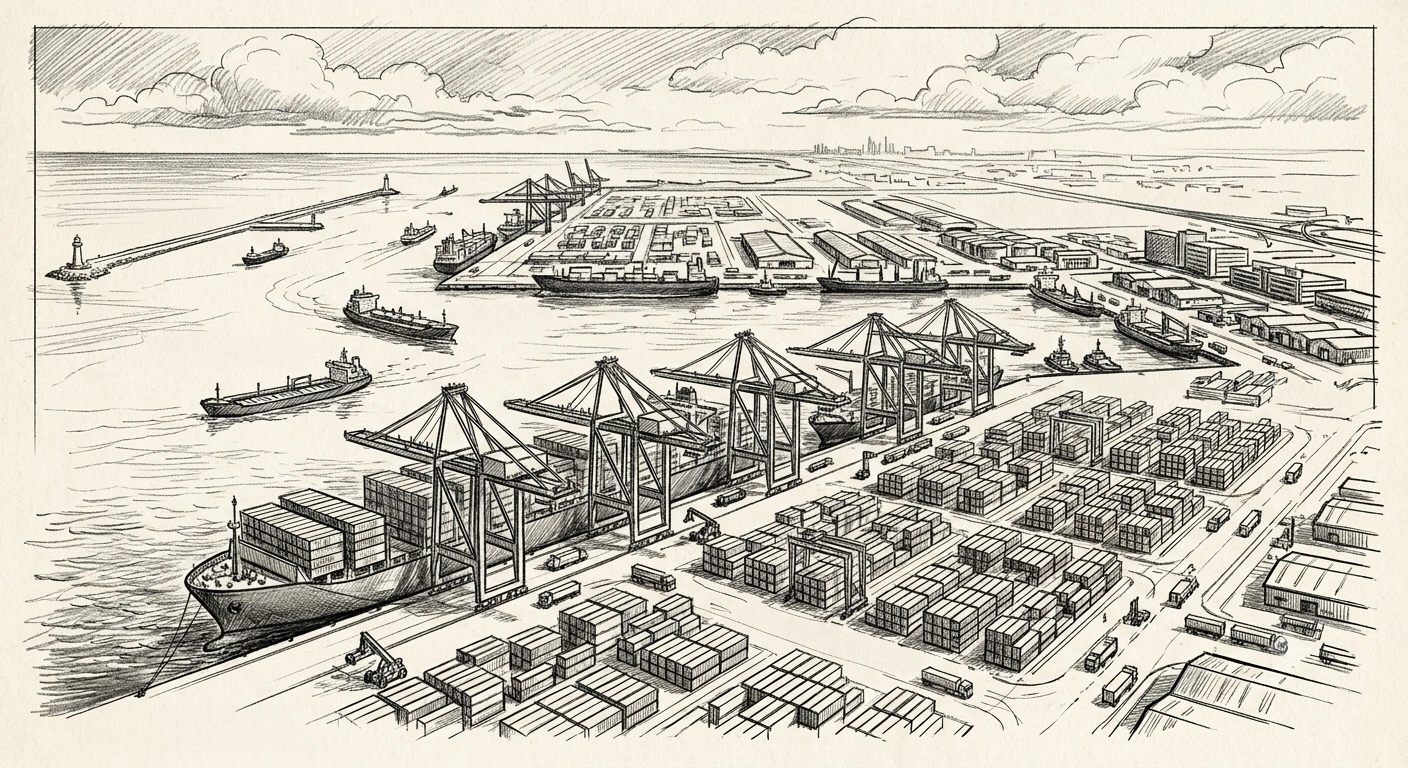
Containers arrive at the Port of Mombasa carrying machinery, consumer goods, raw materials and industrial inputs. Others leave carrying tea, coffee, horticultural products and manufactured goods. Around the port sits an economy of transporters, clearing agents, warehouses, hotels and traders.
But the industrial ecosystem that turns a port into a centre of manufacturing, processing, distribution and regional commerce has remained comparatively underdeveloped. That is what makes the proposed Special Economic Zone in Jomvu potentially more important than its headline numbers suggest.
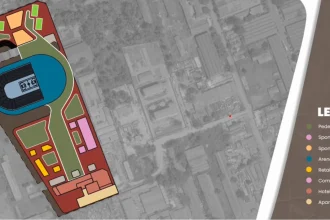
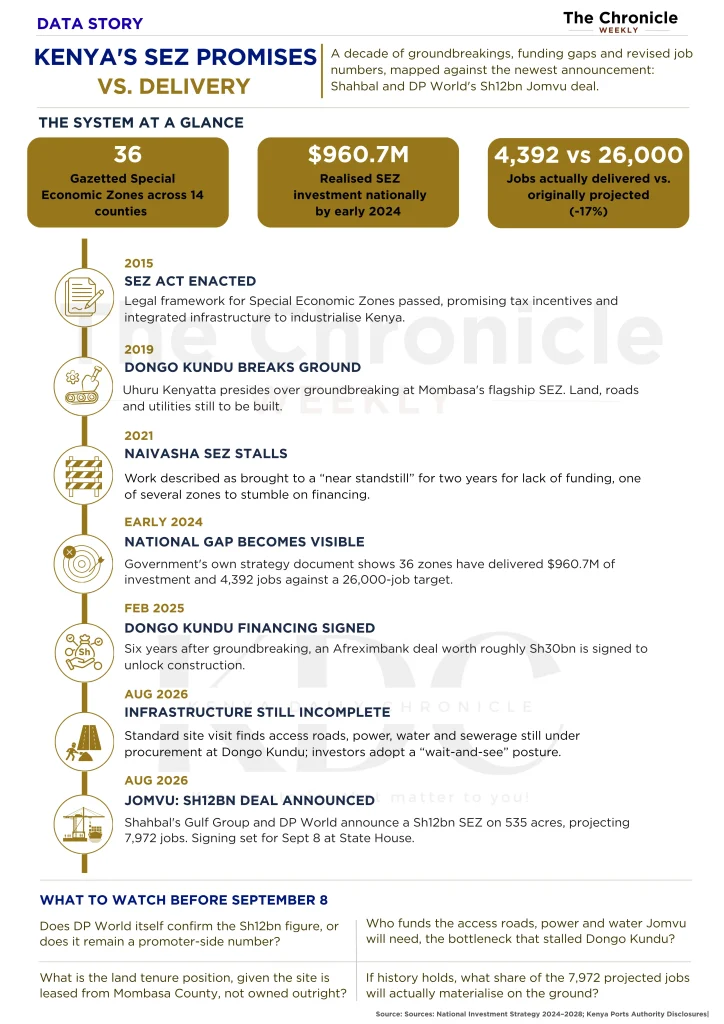
The project announced this week by Suleiman Shahbal’s Gulf Group of Companies, in partnership with DP World, is being presented as a Sh12 billion investment on 535 acres, with a projection of 7,972 direct jobs and participation by 67 companies.
The formal signing is scheduled for September 8 at State House. Those figures should still be treated as announced projections rather than delivered economic outcomes, particularly since DP World’s public disclosure has so far been less expansive on the investment value, and the agreement remains subject to formal conditions.
There is a more interesting question than whether those numbers are eventually reached. What if the real significance of the project is that it could begin to change the economic function of the Coast?
Model Bigger Than A Port
A useful way to assess the proposal is to look at what DP World has built elsewhere. Its flagship example is Jebel Ali Free Zone, or Jafza, in Dubai. The free zone was established in 1985, a year after Jebel Ali Port opened, and the two have evolved as an integrated commercial ecosystem.
Four decades later, Jafza has more than 11,000 companies and has generated $190 billion in trade in the 12 months to May 2025. DP World describes the model as an ecosystem of a major port, logistics infrastructure and business-friendly policies.
The lesson for Mombasa is not that Jomvu will become Dubai. The lesson is that the economic value of a port can change dramatically when businesses are given reasons to locate around it. A container arriving in Mombasa has limited economic significance for the Coast if it is merely trucked onward to an inland destination.
The economic value grows if that container enters a factory in Jomvu, where imported components are assembled; a cold-storage facility, where agricultural products are processed; a distribution centre, where goods are repackaged for the East African market
The second useful benchmark is DP World’s Caucedo operation in the Dominican Republic. New research by Oxford Economics published in April 2026, found that Caucedo Port supports about $269 million in GDP and nearly 5,000 jobs, while also creating the infrastructure and connectivity for a much larger future export opportunity.
Ports create the first layer of value through cargo handling, while logistics creates another through warehousing, freight forwarding, transport and distribution. Manufacturing and processing through value addition, and services create others.
This is why the proposed Jomvu project should not ultimately be judged by the number of factories inside its boundary. Its success should be measured by the number of businesses outside the boundary that become viable because the ecosystem exists.
That could mean a Kenyan manufacturer sourcing more cheaply through Mombasa or a Tanzanian or Ugandan distributor locating its regional inventory on the Coast.
It could mean seafood processing, pharmaceuticals, food processing, light assembly, automotive components or cold-chain businesses discovering that Mombasa is a better place to manufacture for regional markets than importing. The opportunity is therefore not merely to create jobs in an SEZ but an industrial geography.
The African Test Is More Revealing
DP World’s development of Ndayane in Senegal provides an even more relevant comparison because it is an African project rather than a Gulf success story built over 40 years.
The company is developing a deep-water port at Ndayane alongside plans for an economic and industrial zone near the port and Dakar’s international airport. DP World explicitly describes the concept as an integrated multimodal transport, logistics and industrial hub.
That is essentially the strategic question Mombasa now faces. Can the Coast connect port infrastructure, industrial land, logistics, road and rail networks, energy, customs and investment facilitation into one proposition attractive enough to pull in businesses serving the wider region?
Senegal is not yet a finished success story; Ndayane is still being built, with DP World reporting in July 2026 that major dredging had been completed 13 months ahead of schedule and that construction was accelerating towards a planned 2028 completion.
That makes it useful as a benchmark precisely because it demonstrates both the ambition and the difficulty of the model.
A successful port-linked SEZ could strengthen the economic relationship between Mombasa, Kwale and Kilifi while connecting the coastal industry efficiently to Nairobi and the wider East African hinterland.
The logic is straightforward since a business does not choose a manufacturing location simply because there is cheap land. It chooses a location where the total cost of getting inputs in and finished products out makes commercial sense.
That means reliable electricity, water, roads, rail, digital connectivity, customs efficiency, warehousing, skilled labour, access to finance, predictable regulation, and, crucially, proximity to a port.
Mombasa already possesses the last advantage, and the SEZ’s job is to make the others credible. If that happens, the Coast could begin capturing economic activity currently associated with inland centres. That is how an SEZ stops being an estate of factories and becomes an economic ecosystem.
Kenya Has To Solve Its Own History
Kenya has spent years announcing SEZs faster than it has made them operational, and the Dongo Kundu experience is the obvious warning. The project has long been presented as one of the Coast’s major industrial bets, yet financing, infrastructure and investor readiness have repeatedly delayed its development.
The problem is not that the concept lacks merit, but that industrial investors cannot operate on concepts. They need serviced land, power, water, sewerage, access roads, secure tenure and clarity over who is responsible for what.
DP World’s global experience may reduce some of the commercial and logistical uncertainty, but it cannot by itself fix every Kenyan constraint. The operator can connect the project to global trade networks. It cannot single-handedly guarantee electricity reliability, resolve land issues, build every access road or eliminate bureaucratic delays.
The Coast, therefore, needs to think of the project not as a private investment sitting on 535 acres, but as an economic platform whose success depends partly on what happens outside those 535 acres. That is the central lesson from Jafza, Caucedo and the emerging Ndayane model: the port is the anchor. It is not the economy.