
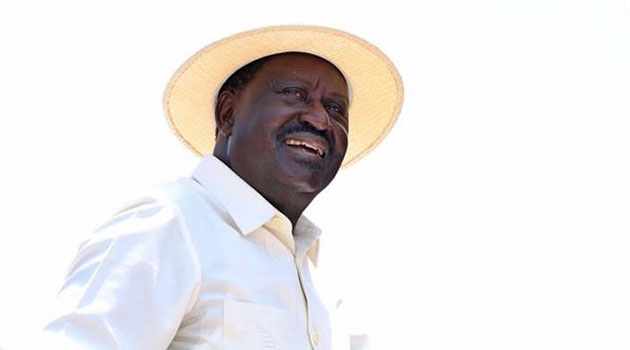
Raila Amolo Odinga, one of Kenya’s most consequential political figures and a central player in the nation’s democratic journey for over four decades, has died at the age of 80.
Born on January 7, 1945, in Maseno, Kisumu County, Raila was the son of Jaramogi Oginga Odinga, Kenya’s first Vice President and one of the country’s independence heroes. From his father, he inherited not just a famous name, but a lifelong commitment to political struggle, justice, and reform, traits that would define his storied life.
Raila’s early education took him through Maranda and Kisumu Union primary schools, before joining Maranda Secondary and then the prestigious Maseno School. He later pursued mechanical engineering studies in East Germany, attending the Technical University of Magdeburg.
During this period, he was exposed to socialist ideas that would profoundly shape his political philosophy, influencing his later focus on social justice and economic equality in Kenya.
Returning to Kenya in the early 1970s, he lectured at the University of Nairobi and later ventured into business, establishing East African Spectre, a gas cylinder manufacturing company.
This was a rare feat for a Black Kenyan entrepreneur at the time, given the systemic barriers and limited opportunities for indigenous business ownership during that era.
Imprisonment and the Struggle for Multiparty Democracy
Raila’s political life was defined by defiance and an unwavering commitment to democratic ideals. Following the 1982 coup attempt, he was detained for nearly a decade without trial, accused of involvement in the failed uprising against President Daniel Moi’s authoritarian regime.
Those years in prison, marked by isolation, torture, and uncertainty, did not break his spirit; instead, they solidified his resolve to fight for a more just and democratic Kenya. The psychological toll of this period only deepened his commitment to his cause.
Upon his release, he became a vocal advocate for multiparty democracy, aligning with reformist movements that culminated in the reintroduction of political pluralism in 1991.
His resilience and enigmatic political endurance earned him the nickname “Agwambo”, meaning “the mysterious one”, a reflection of both his ability to navigate complex political landscapes and his enduring charisma in the face of adversity.
Political Career: From Opposition to Government
Raila’s formal entry into elective politics came in 1992 when he was elected MP for Lang’ata on a Ford-Kenya ticket.
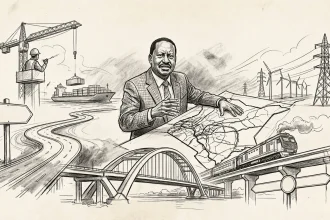
Over the decades, he would go on to serve in various significant roles, including Minister for Energy (2001–2002), where he championed reforms in the energy sector; Minister for Roads, Public Works, and Housing (2003–2005), overseeing critical infrastructure projects; and most notably as Prime Minister of Kenya (2008–2013) in a Grand Coalition government formed after the disputed 2007 elections.
He ran for the presidency five times, in 1997, 2007, 2013, 2017, and 2022, each campaign leaving an indelible mark on Kenya’s political landscape.
While victory at the presidential ballot eluded him, his persistence and unparalleled ability to mobilise millions made him a powerful symbol of democratic resistance and a voice for the marginalised.
His leadership in the Orange Democratic Movement (ODM) transformed it into one of Kenya’s most enduring and influential political parties.
Raila was very instrumental in the enactment of the 2010 Constitution having led the defeat of the government in an unpopular draft constitution in a 2005 referendum.
The Handshake and Statesmanship
In 2018, following the tense and divisive 2017 election period, Raila stunned the nation by shaking hands with his longtime rival, President Uhuru Kenyatta, in what came to be known simply as “The Handshake.”
It was a profound gesture of reconciliation that redefined Kenyan politics, ushering in a period of relative calm, reducing political tensions, and fostering a sense of national unity. This historic moment also birthed the Building Bridges Initiative (BBI), a comprehensive reform agenda aimed at addressing ethnic division, corruption, and electoral injustices.
His final major political project involved the formation of a Broadbased Government after securing a cooperation agreement with President William Ruto. This led to the appointment of opposition figures into government, further demonstrating his commitment to national cohesion.
Even in his later years, Raila continued to play a central role in Kenya’s political discourse, championing electoral justice, devolution, and pan-African cooperation, always pushing for a more equitable society.
Pan-African Vision
Beyond Kenya, Raila was a prominent voice in continental affairs. He served as the African Union’s High Representative for Infrastructure Development, where he passionately advocated for interconnected transport and trade networks to unite Africa economically and socially. He notably championed projects aimed at fostering regional integration. His Pan-African ideals positioned him as a crucial bridge between generations of African leaders, advocating for a stronger, more unified continent.
In 2024, Raila sought to become the African Union chairman in a process that was backed by the Kenyan government. He, however, lost the election to Djibouti’s candidate, a outcome that highlighted the complex dynamics of continental politics.
Legacy
Raila Odinga’s life was one of sacrifice, conviction, and unwavering resilience. He endured prolonged imprisonment, political betrayals, and multiple electoral defeats, yet never abandoned his profound belief that Kenya could be more democratic, more just, and more inclusive.
To his millions of supporters, he was affectionately known as “Baba”, a revered father figure, a liberator, and an indefatigable voice for the downtrodden, who saw him as their champion against oppression.
To his critics, he was often seen as a relentless and polarising figure, whose confrontational style sometimes fuelled political divisions. But to all, he was undeniably a giant of Kenya’s political history, whose immense impact transcended the outcomes of victory or defeat, fundamentally shaping the nation’s democratic trajectory.
Family
Raila is survived by his beloved wife Ida Odinga, whom he married in 1973, and their children, Rosemary, Raila Jr., and Winnie. Their firstborn son, Fidel, tragically passed away in 2015. His family remained his steadfast anchor through years of political turbulence and personal triumphs.
“I have been detained, beaten, vilified, and cheated, but I have never stopped believing in Kenya. One day, justice must prevail.”
Raila Odinga, speaking at Uhuru Park, 2005.