



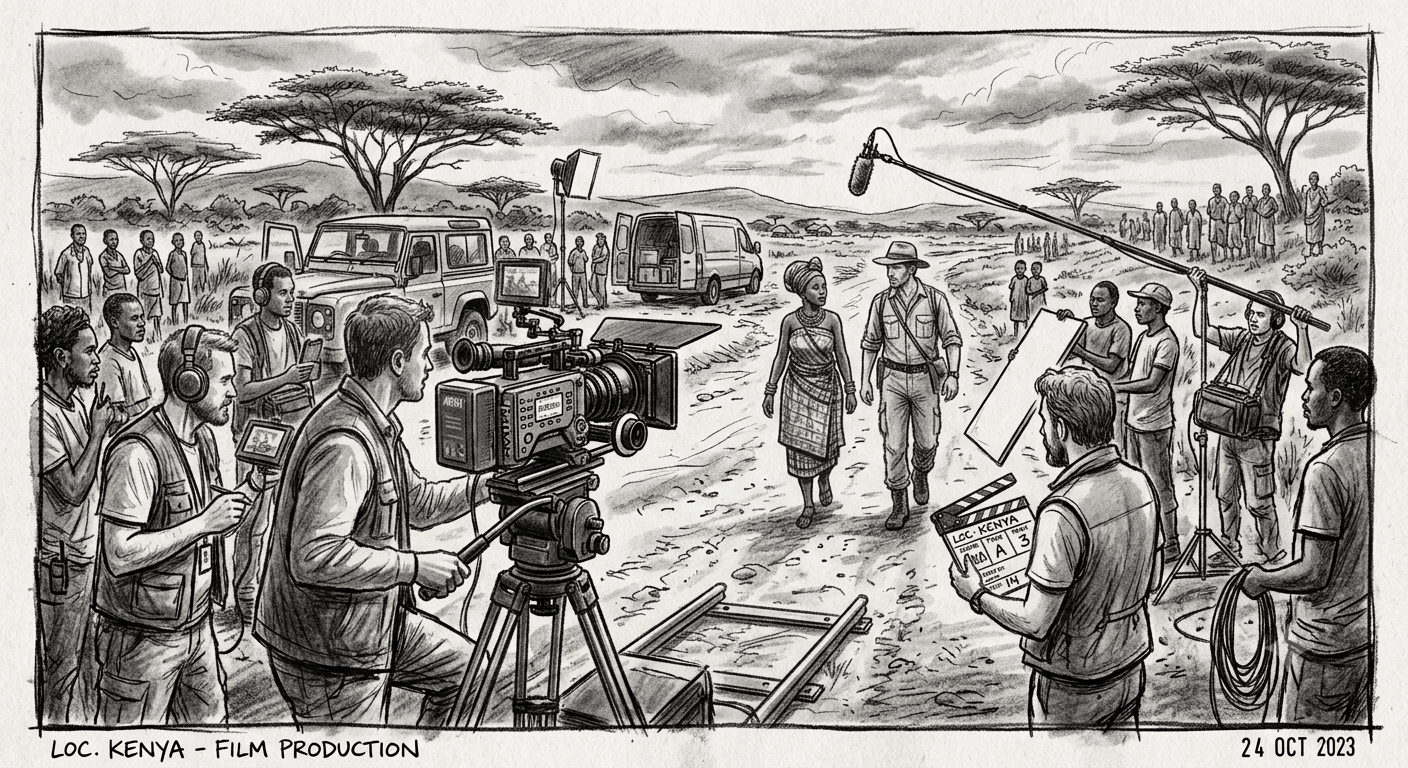
When The Agency Season 2 dropped on Paramount+ last week, Nairobi and Kisumu were among its key filming locations. Jodie Turner-Smith, one of the show’s stars, told interviewers that Kenya was one of the most outstanding locations, praising the people and the weather.
The CIA spy thriller starring Michael Fassbender, produced by George Clooney, is now streaming globally. Kenya’s skyline is in it. Kenya’s streets are in it. Kenya’s people are in it.
Kenya’s name is not in the credits as a co-producer. Kenya’s industry did not retain the intellectual property. Kenya’s filmmakers did not negotiate the distribution rights. What Kenya received was location fees, some hospitality spend, and, in the government’s framing, brand visibility.
This is the central tension of the creative economy moment Kenya finds itself in: a country that has become genuinely desirable as a backdrop while remaining structurally marginal as an author.
To be fair to the government, it has moved. On May 2, 2026, at the Kalasha International Film and TV Awards, President Ruto called on Parliament to accelerate the passage of the Creative Economy Bill 2026, and urged lawmakers to strengthen copyright laws to protect artists’ rights and ensure fair compensation.
The President also announced an increase in government funding for the creative industry to Sh1 billion. He asked the National Treasury to fast-track film incentives, and committed to channelling 30 per cent of state advertising through creative platforms.
These are not trivial commitments. A billion shillings in sector funding, a dedicated State Department, a legislative framework for copyright, on paper, this is the infrastructure of a serious creative economy.
The Creative Economy Bill proposes to establish the Kenya Audio-Visual and Cinema Commission, create a Kenya School of Film and Creative Arts, and set up a Creative Industry Development Fund to provide financial support.
But the same bill that promises protection also introduces significant state power over the industry it claims to be liberating. Section 26(2)(e)(iv) would empower the Kenya Audio-Visual Regulatory Authority to issue takedown orders for content deemed unclassified, prohibited, or in contravention of any law, a provision whose scope for abuse concerns legal observers.
A creative economy framework that can mute the voices it funds is a contradictory proposition.
The IP Problem
The deeper issue predates the current administration. Kenya’s film and television industry generated approximately Sh8.2 billion in 2023, yet industry stakeholders estimate that producers capture less than 30 per cent of the potential revenue their content generates across its lifecycle.
The problem is not a shortage of Kenyan talent: Country Queen on Netflix and Sincerely Daisy on Showmax have demonstrated global competitiveness. The problem is structural: poorly negotiated contracts, undefined exploitation rights, and an industry culture that has historically prioritised production over ownership.
When a foreign production arrives in Kenya, brings its own IP framework, shoots on Kenyan soil, casts Kenyan faces in supporting roles, and then distributes globally with all rights retained, the economic equation is clear. Kenya gets the fee. The network gets the catalogue.
This is not exploitation in any dramatic sense; it is simply what happens when one party has an IP strategy, and the other does not.
Which is why the film premiering at Prestige Cinema on July 31 matters beyond its running time. Anam’s Wake, written and directed by Likarion Wainaina, is a psychological thriller set against the backdrop of African mourning rituals and traditions.
It follows Anam, a professional mourner trained to summon death and negotiate the passage of souls, who remains emotionally numb after her own mother’s death sixteen years earlier.
When tasked with her first solo ritual at the influential Ebale family home, what begins as a solemn wake spirals into a chilling ordeal as long- buried family secrets surface and Anam discovers the ritual was never truly about the deceased patriarch. The significance extends past the story.
Anam’s Wake is a Kenyan IP story. Conceived, written, directed, produced, and cast in Kenya, by Kenyans, drawing on specifically Kenyan cultural material: mourning rituals, the weight of unacknowledged grief, the particular texture of family obligation in this part of the world.
Its cast includes Marima Wanjiru, Sam Omondi, Peter Kawa, Vanessa Okeyo, Ruth Apondi and Gathoni Mutua; names that Kenyan audiences are building relationships with, not visiting stars brought in to give a foreign production continental credibility.
The distinction sounds abstract. It has direct economic consequences. When a Kenyan film retains its IP, the distribution deal is a negotiation rather than a surrender.
The sequel, the merchandise, the international sale, the streaming licence, all of these accrue to the people who made it. The film becomes a long-term asset rather than a one-time transaction.
The Terms of Integration
Kenya’s integration into the global creative economy is proceeding on two parallel tracks that rarely intersect. On one track: foreign productions attracted by the landscape, the labour costs, and the access to the East African terrain.
On the other: a domestic industry slowly building the infrastructure, the legal frameworks, and the cultural confidence to tell its own stories on its own terms.
The government’s instinct has been to pursue both simultaneously, attract the foreign dollar while funding the local filmmaker, without fully reckoning with the tension between them.
Tax incentives that attract Hollywood without requiring co-production clauses, IP-sharing requirements, or training levies do not build a domestic industry. They build a location service industry, which is a different and more precarious thing.
Kenya has the stories. The question the Creative Economy Bill, the Kalasha commitments, and every foreign production deal should be forced to answer is the same one Anam’s Wake implicitly poses: who gets to own them?