





We live in an era where celebrities record themselves carrying out illegal activities or admitting to past crimes, seemingly emboldened by social media’s appetite for sensational content.
In March 2022, comedian and activist Eric Omondi sparked widespread debate after posting a video of himself burning what appeared to be his national identification card.
With Lucky Dube’s song “Prisoner” playing in the background, Omondi set the card alight while issuing a seven-day ultimatum to presidential candidates Raila Odinga and William Ruto, demanding they present a clear agenda for addressing youth unemployment.
Omondi appeared to overlook the serious legal consequences of his actions. Section 133 of the Kenyan Penal Code states that anyone who “knowingly and without lawful authority or excuse destroys, mutilates, defaces, alters, abandons, or fails to preserve any statutory document” is guilty of an offence.
The law specifically identifies identity cards as statutory documents, and conviction carries a fine of up to Sh5,000, imprisonment of up to six months, or both. While the ID featured Omondi’s image, critics questioned whether he burned his genuine card or a duplicate.
Some social media users challenged him to “burn the original if you are a gangsta”, while others dismissed the act as a publicity stunt.
King Kaka’s Certificate Confession
Fast forward to this month, and rapper King Kaka (real name Kennedy Ombima) has publicly admitted to once running an illicit business creating fake academic certificates and payslips.
In a reflective video shared on social media in June 2026, the Wajinga Nyinyi hitmaker disclosed that as a struggling 23-year-old graphic designer, he used his skills to produce counterfeit documents he described as “original fake certificates.” “I used to make fake payslips and fake certificates. Original fake certificates,” King Kaka confessed. “I made a lot of people get into universities and higher- paying jobs.”
The rapper recounted how he was introduced to the lucrative world of printing unverified corporate and academic documentation while seeking higher profit margins in Nairobi’s River Road area. He described the meticulous precision he brought to the trade to ensure the documents bypassed institutional scrutiny.
To his surprise, several clients later returned to thank him after successfully securing employment or gaining university admission using his counterfeit designs.
King Kaka publicly apologised to Kenya’s Ministry of Education, acknowledging that his past actions had directly undermined the country’s education system.
He attributed his behaviour to youthful desperation, peer pressure, and a lack of mentorship, and cautioned young people: “Don’t be like me when I was young. Be legit.”
A Confession is Not a Pardon
While King Kaka framed his admission as a cautionary tale, the legal reality is far more sobering. In Kenya, presenting a fake academic or professional certificate to any public entity is a serious criminal offence, and public confessions do not grant immunity from prosecution.
Employment secured using forged documents is considered null and void. The Public Service Commission (PSC) enforces automatic termination of civil servants found with fraudulent credentials.
Its 2023/2024 Annual Compliance Report recorded the dismissal of 449 civil servants who had used fake academic certificates to secure employment and promotions, representing 52.3 per cent of all employees found with fake certificates.
Out of 1,019 officers identified, action was taken against 744. The PSC warns that forgery is a criminal offence that could lead to prosecution and dismissal. Culprits also forfeit any right to pension, unpaid allowances, or accrued leave.
The PSC has directed institutions to terminate the service of any officer found to have used forged certificates and forward their names to the Ethics and Anti-Corruption Commission (EACC) for further action.
The EACC is legally empowered to recover 100 per cent of all salaries, allowances, and benefits fraudulently earned during the entire period of employment, even if the individual worked for years.
Recent cases illustrate the severity of this measure. In May 2026, the EACC arrested Mercy Akinyi Ofuwa, a former employee of the Office of the Auditor General, who allegedly used a forged KCSE certificate to secure employment.
She faces charges of forgery, uttering a false document, and fraudulent acquisition of public property amounting to Sh5,838,790 in salaries and benefits. Separately, the EACC has filed civil proceedings to recover Sh37 million from a senior IEBC official who used a forged degree certificate to secure employment.
What the law says
Offenders are prosecuted in Anti-Corruption Courts on multiple counts:
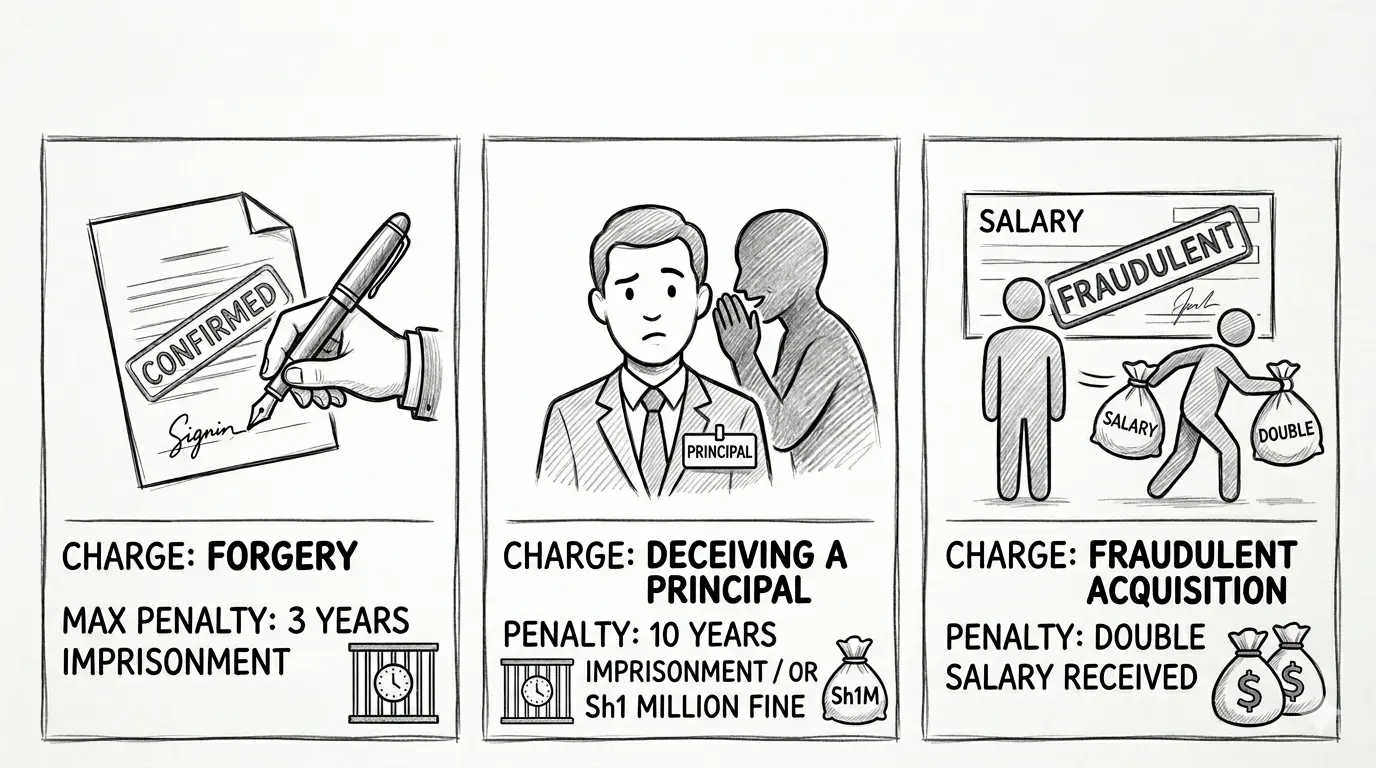
Forgery and Uttering False Documents: Under Section 349 of the Penal Code, any person who forges a document or electronic record is guilty of a felony and liable to imprisonment for three years. Forgery is defined as “the making of a false document with intent to defraud or to deceive.”
Deceiving a Principal: Under Section 41(2) of the Anti-Corruption and Economic Crimes Act (ACECA), an agent who gives their principal a document they know contains false or misleading information is guilty of an offence. Conviction carries a fine of up to Sh1 million, imprisonment of up to 10 years, or both.
Fraudulent Acquisition of Public Property: Under Section 45 of ACECA, convicts face mandatory fines equal to double the salary or benefit received, plus severe prison terms for those unable to pay.
Crackdown Already Underway
King Kaka’s admission comes amid a significant government offensive against forged academic credentials. The EACC has raised alarm over increasing cases of academic fraud and plagiarism, warning that the trend is eroding public trust in institutions.
The Kenya National Examinations Council (KNEC) has launched a digital verification system enabling employers and universities to instantly validate KCSE certificates.
Following PSC and EACC reports identifying over 2,000 forged certificates in the public sector, the government has intensified verification measures across institutions.
EACC Secretary Abdi Mohamud has also warned that the period leading up to elections often sees a surge in attempts to forge academic documents, with the Commission particularly targeting universities, colleges, and examination bodies with lax verification systems ahead of the 2027 General Elections.
King Kaka’s confession has generated mixed reactions online. Some followers questioned the sincerity of his advice: “Hii advice ni weird sana. Which is which?” wrote one user.
Others jokingly warned that law enforcement could take an interest: “DCI looking for you,” commented another. Stephan Ndegwa observed, “Enyewe tuko Africa, that such confessions come without consequences and cancellations!” while Lince Muiga quipped: “Unataka kukujiwa na Subaru ya colour gani Rabbit.”
The levity, however, masks a serious point. The trend of Kenyan celebrities confessing to crimes online reflects a dangerous misconception that public admissions somehow reduce legal liability. They do not.
The law does not distinguish between past and present offences, and public confessions can, and often do, form the basis for prosecution.
As the PSC has made clear, forgery is a criminal offence that leads to prosecution and dismissal from employment.