




Kenya’s proposed vision to “First World” status rests on three pillars and a promise to outlast electoral cycles, but the report’s own numbers, its silence on financing and political cost, suggest the harder questions haven’t been tackled. What Kenya has been presented with is less a finished development plan than the opening argument for one.
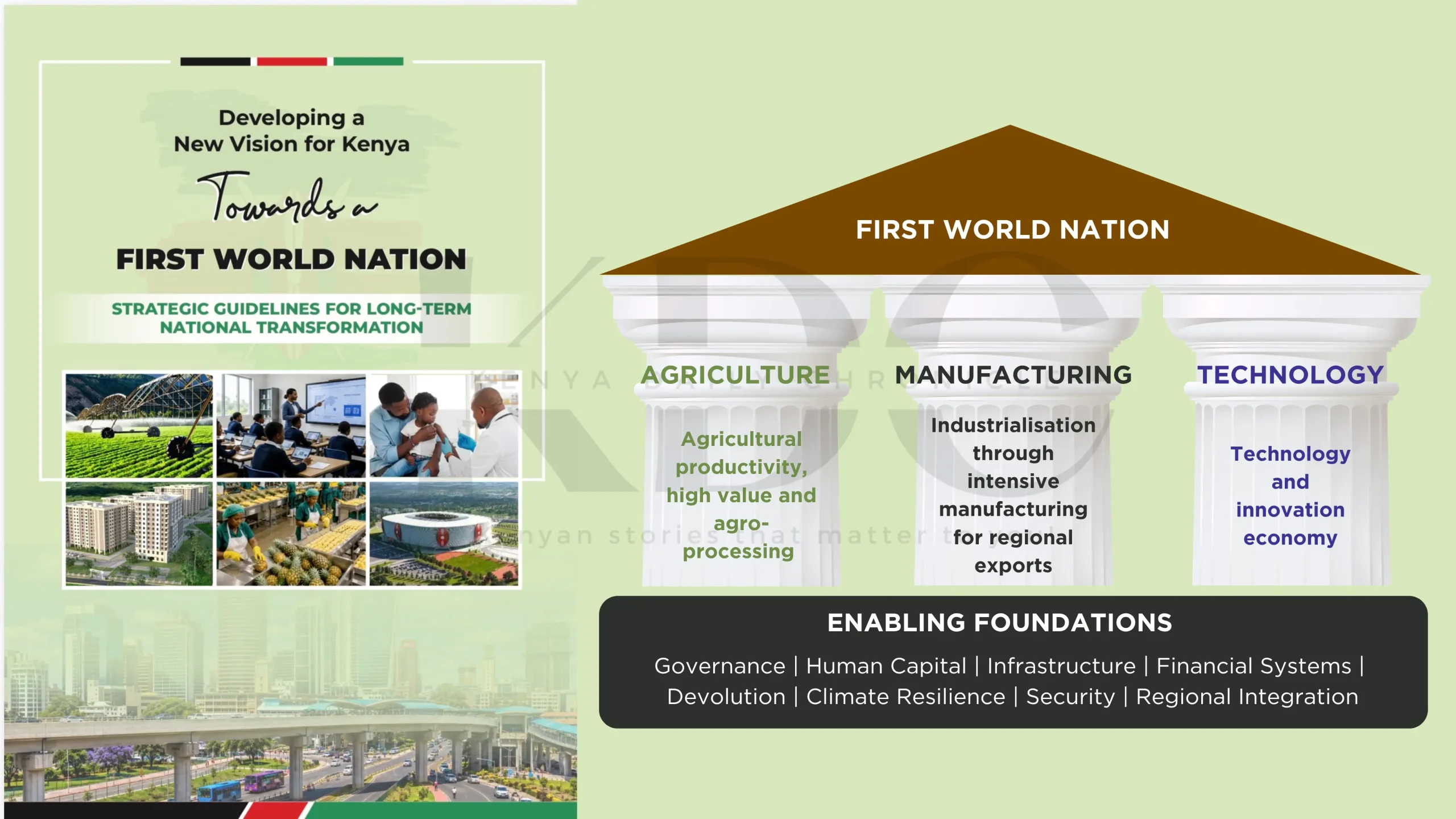
Developing a New Vision for Kenya: Strategic Guidelines for Long-Term National Transformation sets out a 30- to 40-year path from lower-middle-income status to what it calls a “First World” nation, defined not just by higher GDP but by high incomes, strong human development, effective institutions, reliable public services, formal employment, rule of law, safety, innovation and lower poverty and inequality.
Its central insight is also its most uncomfortable: Kenya’s problem has not been a lack of plans, but an inability to sustain progress.
The report labels this Kenya’s “development paradox”; a cycle in which growth and reform are repeatedly interrupted by political crises, governance failures, policy reversals and new priorities before earlier ones mature.
Kenya has shown it can get development right, but has struggled to keep doing so long enough. That is the real challenge behind the new Vision. The three pillars matter, but they are not the whole story.
Kenya cannot become a high-income industrialised society by choosing the right sectors alone. It must build the state, workforce, infrastructure, financial system and political consensus needed to sustain those choices over decades.
East Asian Sequence
The report argues that raising smallholder productivity is the fastest route to higher incomes, poverty reduction and food security. Its prescriptions include irrigation, stronger extension services, agricultural research, better access to seeds and fertiliser, climate-resilient farming, rural roads, secure land tenure and stronger markets.
However, the goal is not subsistence agriculture with better inputs, but a shift toward higher-value production, agro-processing and stronger links between farms and industry.
The second pillar is industrialisation through manufacturing and value addition, with an emphasis on export-oriented production. Kenya’s high cost of production is identified as a major constraint, and the proposed response is to position the country as a manufacturing and assembly hub for domestic and regional markets.
Here, the report draws heavily from East Asia, where governments supported firms with credit, infrastructure and technology, but expected them to become competitive.
The lesson for Kenya is that industrial policy cannot become a permanent subsidy for weak firms. The state must create the conditions for growth, but firms must deliver productivity and performance.
The third pillar is technology, innovation and the knowledge economy. Kenya already has a digital base, but the report argues that technology must become an economy-wide productivity tool, not just a feature of selected sectors.
Research institutions, universities, technical training and innovation finance must be tied to industry. The plan does not imagine Kenya becoming a technology economy simply by expanding internet access. It argues that technological capability is built through production: firms learn by making, competing, exporting and upgrading.
Agriculture and manufacturing, therefore, provide the base from which Kenya can move into higher-value activities. In short, the report is not proposing three parallel pillars so much as a chain: agriculture creates surplus and demand; manufacturing turns that into industrial capability; technology lifts the economy into higher-value activities.
The Foundations
But that chain only works if the foundations beneath it hold. The foundations are where the real battle lies.
The report highlights eight enabling foundations: integrity, governance and state effectiveness; human capital and social wellbeing; infrastructure and connectivity; devolution, urbanisation, and social development; supportive financial systems; environmental sustainability and climate resilience; peace, security, and social cohesion; and regional integration and global competitiveness.
The report is clear: transformation requires an ethical professional and capable public service able to implement policy consistently.
The East Asian examples it mentions were not just stories of clever economics, but governments that could coordinate investment, discipline institutions, and maintain direction over time.
Kenya’s own record demonstrates why this matters. Corruption, weak accountability, poor public finance management and limited institutional capacity have continually hindered implementation.
The solution is not simply another reform programme, but a restructuring of the machinery through which the state delivers development. A stronger developmental state will also have more discretion, which makes transparency and accountability even more essential.
Education, skills, healthcare, housing and social protection are treated as part of the agenda, not as separate social policies. Kenya cannot industrialise while treating its population as cheap labour. It requires a workforce that can move into skilled manufacturing, services, technology and innovation.
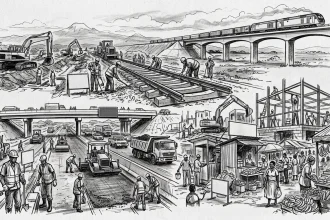
The third foundation is infrastructure and connectivity. The report goes beyond roads and bridges to include irrigation, electricity, logistics, digital connectivity and urban infrastructure as part of the productivity system. This is also where ambition meets fiscal reality.
Rising debt and high debt-servicing costs are already crowding out development spending, yet the transformation proposed will require sustained investment.
The report says financing must mobilise resources for productive investment while remaining fiscally sustainable. That is right, but the real test will be whether the full plan shows the arithmetic: what it will cost, what will be public or private, what role development finance will play, and what gets prioritised when resources fall short.
Devolution, Urbanisation and Inclusion
The report recognises that Kenya will become majority urban around 2050 and argues that housing, transport, livelihoods, education and health must be planned accordingly. This is inseparable from devolution. Agriculture, health, water, urban development and local infrastructure are shared, or devolved functions, and the report calls for national and county governments to integrate plans and “deliver as one.”
The diagnosis is correct, but the challenge is huge. Kenya’s development system is shared between two levels of government with distinct mandates, resources, and incentives. Coordination will require clear responsibilities, predictable financing and mechanisms for resolving disputes.
The report notes that climate shocks already cost Kenya almost 5 per cent of GDP annually, while droughts and floods affect millions. Agriculture, manufacturing and urbanisation all depend on infrastructure and production systems that can survive a changing climate.
The Missing Foundation: Political Economy
The report also includes peace, security, social cohesion and national identity, plus regional integration and strategic partnerships. These are not decorative. A 30- to 40-year programme requires a society that can absorb disruption without losing common purpose.
The report proposes a national development law requiring Medium-Term Plans, county plans, sector strategies and annual budgets to align with the Vision. It even suggests that party and presidential manifestos should be consistent with it.
The rationale is clear: Kenya’s priorities have too often been reset after elections. But the proposal raises a hard question: how does Kenya protect long-term continuity without narrowing democratic choice?
The proposed answer is the National Economic and Social Council (NESC), supported by an independent delivery secretariat. It is to coordinate implementation, review progress, commission research, and recommend corrections across national and county governments, the private sector, academia and other stakeholders.
This is perhaps the report’s most important institutional idea, because a 30- to 40-year transformation cannot be managed as a series of disconnected five-year plans. However, the NESC will only matter if it has authority and independence to tell politicians when policies are failing.
The document is strongest when explaining why Kenya needs a new development model and what successful transforming economies had in common.
It is also strongest when it acknowledges Kenya’s constraints: manufacturing is still low, most employment is informal, youth joblessness remains severe, debt is squeezing fiscal space, climate shocks are costly, and institutions remain weak. These are not problems that can be solved by writing a better plan.
The report’s next steps – sector strategies, flagship projects, a five-year Medium-Term Plan and national consultation – show that this is a beginning, not a blueprint. The real plan has not yet been written.
The next stage must turn three pillars and eight foundations into choices about money, institutions and trade-offs. It must decide who pays, who implements, what gets prioritised and how success will be judged.
Kenya’s new Vision rests on a sound premise: countries do not become prosperous by accident. They do so through sustained policy choices, capable institutions, productive investment and political commitment. Now comes the harder part: proving that Kenya can build the state strong enough to carry the weight of its own ambition.