




Every major city eventually reaches a moment when building more roads stops solving its transport problems. Nairobi reached that point years ago.
The city’s population has expanded far beyond what its road network was designed to accommodate, suburban growth has stretched commuting distances, and economic activity has become increasingly concentrated in a few corridors that experience crippling congestion every morning and evening.
The result is a transport system that imposes enormous costs on businesses, households and government alike through lost productivity, higher logistics costs, pollution and declining quality of life.
Against that backdrop, the proposed Nairobi Mass Rapid Transit System represents one of the most consequential infrastructure decisions Kenya could make over the next decade.
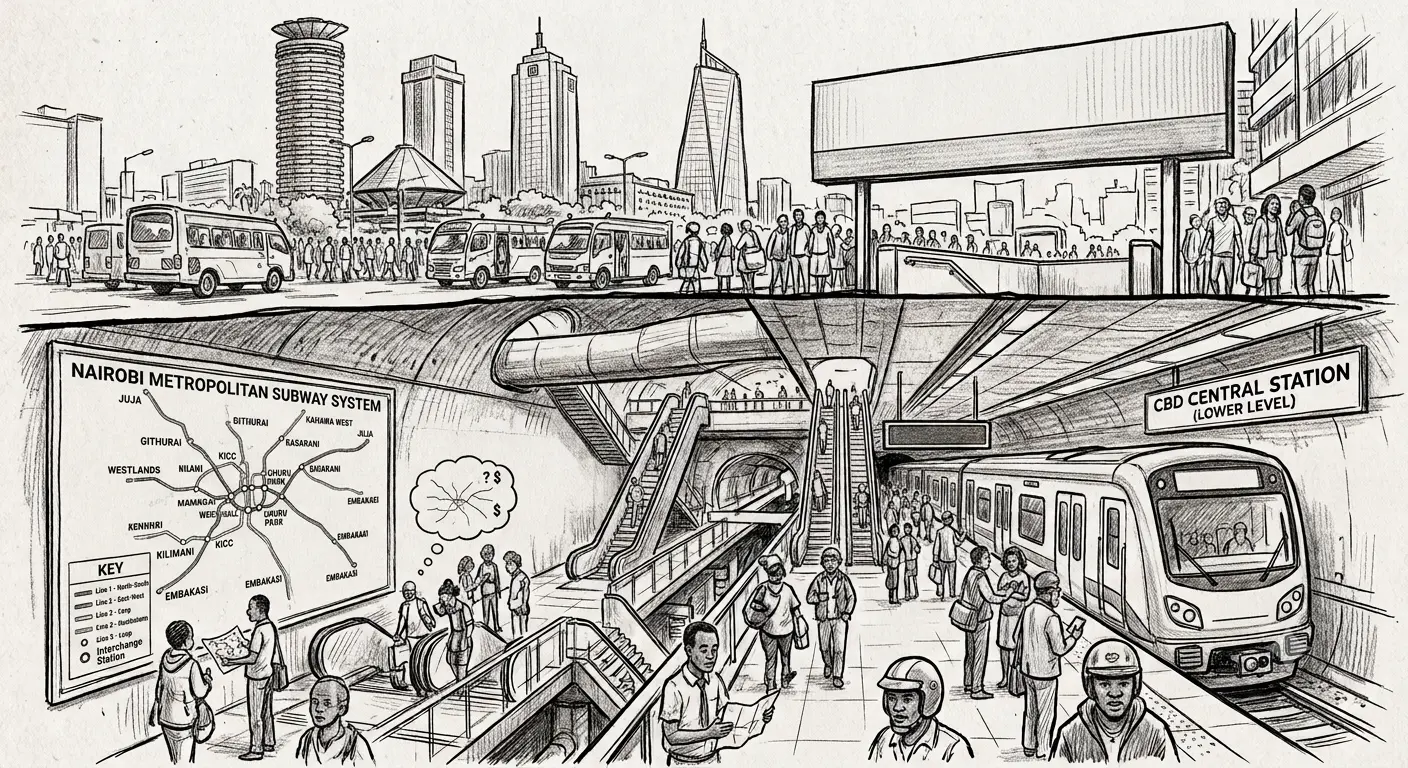
The proposal, recently presented to the Nairobi County Cabinet and the President, envisions an integrated transport system that combines rail, bus rapid transit and coordinated land-use planning rather than treating each mode of transport as a separate project.
It recognises that successful cities do not simply build transport infrastructure; they organise urban growth around efficient mobility networks.
That ambition deserves serious consideration because Nairobi undoubtedly needs a modern mass transit system. Yet support for the project should not mean suspending scrutiny.
The Cabinet should ask harder questions than previous governments have asked, not because Kenya should hesitate to build urban rail, but because Nairobi has already spent decades pursuing versions of the same dream without ever laying the foundations for lasting success.
Nairobi Has Been Here Before
The promise of a modern urban railway is hardly new. Successive governments have announced plans to transform Nairobi’s transport system, often accompanied by impressive feasibility studies, colourful renderings and ambitious completion dates.
The 1948 colonial master plan called for a ring railway and a central business district rail tunnel. The 1972 Nairobi Metropolitan Growth Strategy proposed the same tunnel concept, calling mass rapid transit “the backbone of a sustainable metropolitan transport network.” The 2014 Nairobi Urban Integrated Plan repeated the diagnosis almost word for word. None of the three was built.
Each proposal emerged from the same diagnosis that the city’s dependence on roads and matatus alone would eventually become unsustainable. Each also generated optimism that Nairobi was finally on the verge of joining the ranks of major cities served by efficient mass transit.
Yet none of those plans reached completion. Political priorities shifted, financing became uncertain, institutions failed to coordinate, or projects simply lost momentum as governments turned their attention elsewhere.
The consequence is that Nairobi continues to wrestle with many of the same transport challenges that motivated those earlier proposals, only on a much larger scale as the city’s population and economy have continued to grow.
There are, however, important reasons to believe this proposal could be different.
Unlike many previous attempts that viewed rail primarily as a transport engineering project, the current vision places greater emphasis on integrating transport with urban planning.
The presentation links mobility planning directly with land-use policy along major corridors, recognising that transport infrastructure influences where people live, where businesses invest and how cities expand over time.
That distinction matters because successful transport systems are rarely built in isolation. Around the world, cities that have transformed mobility have done so by treating rail stations as catalysts for housing, commercial development and public services.
Transport becomes not merely a means of moving people but the framework around which economic growth is organised. If Nairobi embraces that broader philosophy, the project could generate benefits that extend far beyond reducing traffic congestion.
The Case for Building It
The economic argument for mass transit is becoming increasingly difficult to ignore. Every hour that commuters spend trapped in traffic represents time that could have been used productively.
Businesses absorb higher transport costs, workers experience longer and more exhausting journeys, while investors increasingly factor urban mobility into decisions about where to locate operations.
Congestion is no longer simply an inconvenience. It has become a constraint on Nairobi’s competitiveness as East Africa’s commercial capital
Building more roads alone cannot solve that problem indefinitely. Experience from cities across the world shows that additional road capacity often attracts additional traffic until congestion eventually returns.
Rail and other forms of high-capacity public transport offer something roads cannot easily provide: the ability to move significantly larger numbers of people within the same transport corridor while using far less urban space.
The proposal also highlights another dimension that deserves greater public attention. Transport is increasingly a public health issue. The presentation draws attention to pollution hotspots along major corridors such as Thika Road and Ngong Road, illustrating how traffic density and surrounding land use contribute to deteriorating air quality across parts of Nairobi.
Reducing dependence on private vehicles and improving public transport, therefore, offers benefits that extend beyond shorter travel times to include cleaner air and healthier urban environments.
A successful mass transit system could also reshape Nairobi’s economy in profound ways. Reliable public transport expands labour markets by allowing workers to access jobs further from home without prohibitive commuting costs.
Businesses gain access to a larger workforce, property development becomes more predictable around transport corridors, and investment follows the certainty that efficient mobility creates.
Cities such as London, Singapore and Addis Ababa demonstrate that transport infrastructure can become an engine for urban transformation rather than merely a response to congestion.
Cabinet Must Ask Better Questions
Supporting the railway should not mean approving it uncritically. If previous proposals failed despite widespread agreement that Nairobi needed better transport, then the critical issue has never been whether the railway is desirable.
It has always been whether the government has adequately prepared for the institutional, financial and governance challenges that determine whether projects succeed or fail.
Cabinet should therefore insist on convincing answers before construction begins.
How will the project be financed without imposing unsustainable fiscal pressure? Which institutions will ultimately own, regulate and operate the system?
How will the existing matatu industry, which carries millions of passengers every day and provides livelihoods for thousands of Kenyans, be integrated into the new transport ecosystem rather than simply displaced?
What mechanisms will ensure transparent land acquisition and minimise costly legal disputes?
Perhaps most importantly, what guarantees exist that the project will survive changes in political leadership and remain a national priority over the decade or more required for implementation?
These are not questions designed to delay progress. They are precisely the questions that should have been answered during previous attempts.
Kenya has reached a point where postponing mass transit carries its own costs. Nairobi’s economy continues to expand, its population continues to grow, and congestion continues to erode productivity.
The city cannot build enough roads to accommodate that growth indefinitely, nor can it rely forever on a transport system that struggles to meet the demands of a modern metropolitan economy. That is why this proposal deserves support. It also deserves rigorous scrutiny.
If the government has genuinely learned from decades of abandoned plans, Nairobi could finally deliver the integrated transport system the city has needed for generations.
If those lessons have not been learned, however, another ambitious proposal risks becoming another chapter in a familiar story of unrealised promises.
Cabinet should therefore ask harder questions this time, not because Nairobi should be reluctant to build the railway, but because the city has waited far too long to get it right.