





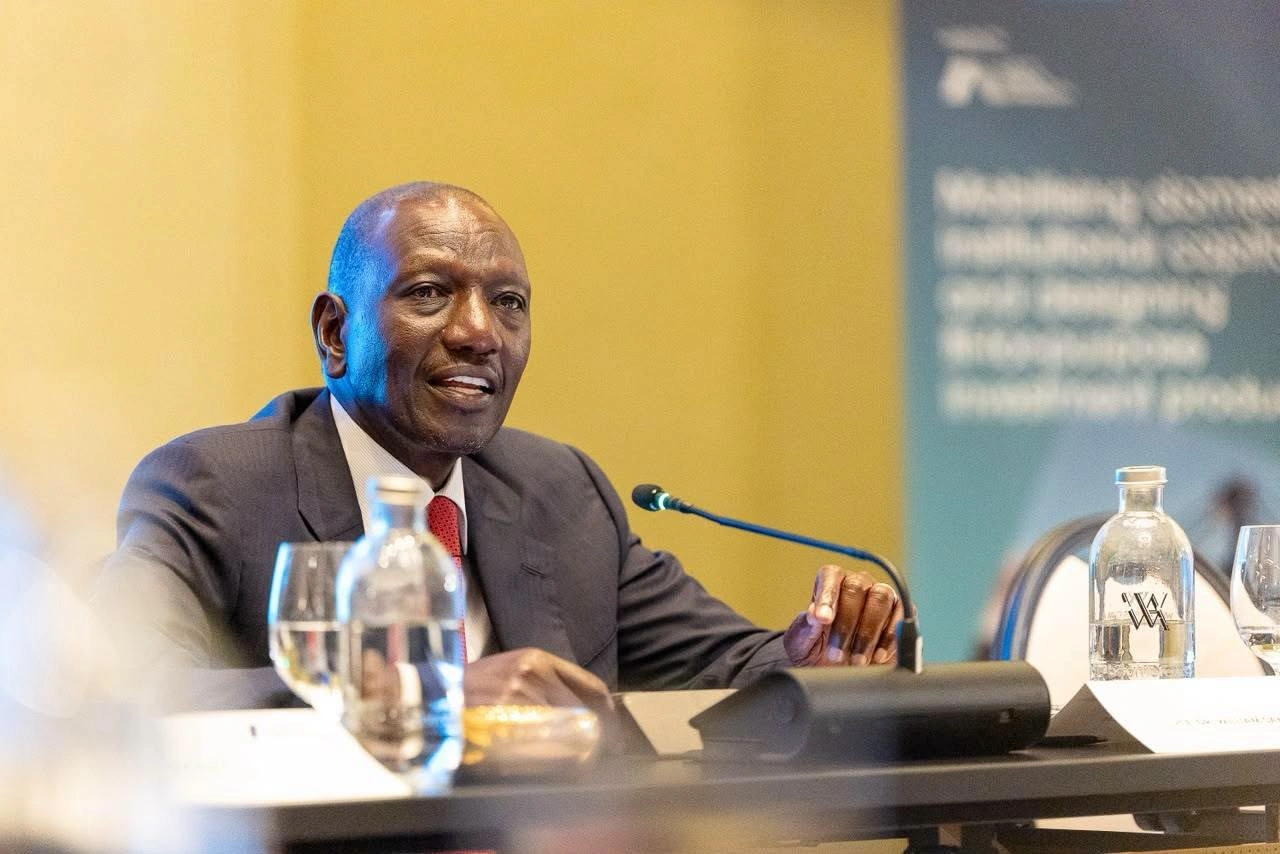
A teacher in Eldoret has paid into a pension fund for twenty years and has never missed a month. Her money, President William Ruto told a New York roundtable of regulators, insurers and development bankers on Monday, is more likely to sit in a Treasury bill than in the geothermal plant an hour up the road from her classroom.
For years, the standard explanation for Africa’s infrastructure and development gap has been straightforward: the continent does not have enough money.
Ruto challenged that assumption, arguing that Africa’s more fundamental problem is not the amount of capital available, but the rules governing where that capital can go.
“Africa’s problem is no longer the amount of capital available to it. Africa’s problem is the set of rules that decide where that capital is allowed to go,” Ruto told the Africa We Build high-level roundtable on the margins of the 81st session of the United Nations General Assembly.
It is a significant shift in the way the financing question is framed.
According to figures cited by the President from the Africa Finance Corporation’s research, African non-bank domestic capital pools have surpassed $2 trillion (Sh259.1 trillion), while pension and insurance assets have crossed $1 trillion (Sh129.5 trillion). By comparison, all external flows into Africa between 2014 and 2024, including concessional and commercial financing, amounted to about $1.7 trillion (Sh220.2 trillion).
The implication is uncomfortable but important: Africa may not need to spend all its energy persuading outsiders to bring capital to the continent if it can make better use of the capital already generated by Africans.
Incentives Are Elsewhere
Kenya provides perhaps the clearest illustration of the problem. Ruto pointed to the country’s pension industry, which he said holds about Sh3.2 trillion, or approximately $24.7 billion. About 46 per cent of those assets are invested in government securities, while only 0.02 per cent is invested in infrastructure debt.
The contrast is striking because Kenyan regulations allow pension funds to invest up to 10 per cent in infrastructure.
That means the problem, at least in the example presented by the President, is not simply that pension funds are prohibited from investing in infrastructure. It is that there are too few investment instruments that meet the requirements of institutional investors while offering an acceptable risk-return proposition.
The fund manager therefore does what the system encourages him to do. A Treasury bill is considered a relatively straightforward and liquid investment. A power plant, by contrast, carries construction, regulatory, currency, political, operational and long-term liquidity risks.
As Ruto put it: “Capital follows incentives, and we wrote the incentives.” This is where the argument moves beyond a familiar complaint about African risk.
The President is effectively asking whether the continent’s risk is being measured accurately, and whether the rules designed to protect investors are inadvertently making productive African investments unnecessarily unattractive.
Repricing African risk
Ruto proposed four areas for change. The first is how African risk is priced, calling for methodologies used to assess African investments and sovereign risk to be tested against actual default and recovery data.
He cited a United Nations Development Programme estimate that more objective ratings could save African countries as much as $74.5 billion (Sh9.6 trillion), while acknowledging that the precise figure is less important than the underlying principle.
The second is insurance. Productive African assets, he argued, need insurance and guarantees that do not become so expensive that they undermine the economics of the projects they are supposed to protect.
The third concerns duration. Infrastructure is inherently long-term. Power plants, water systems, ports and transport networks can require decades to generate returns. Rules that treat long-duration African assets as unusually risky or illiquid can therefore discourage precisely the investment needed to build them.
The fourth is what Ruto described as building the “plumbing”. Having money in a pension fund does not automatically mean that money can finance a road, power station or water project.
The project has to be structured into an investment instrument that a pension fund or insurance company is legally and commercially able to purchase. That requires bankable project pipelines, credit enhancement and instruments denominated appropriately for investors and projects.
This may ultimately be the most practical part of the argument. Africa does not simply need more appetite for infrastructure investment. It needs more investable infrastructure.
Test Case
Ruto used Kenya to demonstrate that the government is not approaching the discussion only as a request for changes by international institutions.
He pointed to three credit-rating actions in Kenya’s favour since August last year, foreign-exchange reserves of about $15 billion (Sh1.9 trillion), and the Kenya Pipeline initial public offering, which he described as the largest in the country’s history.
The listing raised Sh112.4 billion, was 105.7 per cent subscribed and ended what he described as an eleven-year drought in Kenya’s equity market.
Kenya has also increased its equity investment in the Africa Finance Corporation by Sh3.25 billion ($25 million), and established the corporation’s first regional office in Nairobi through a Host Country Agreement signed in April.
More significantly, the President pointed to Kenya’s first infrastructure fund listing on the Nairobi Securities Exchange in May. The fund raised Sh3.4 billion, creating an instrument that Kenyan pension schemes could actually purchase.
The amount is small relative to Kenya’s infrastructure requirements. But that is precisely why Ruto presented it as a beginning rather than a solution.
Kenya also signed the National Infrastructure Fund into law in March. According to the President, the fund is designed to mobilise up to $40 billion for roads, ports, power and water through equity participation rather than new public debt.
The proposition is therefore different from the conventional government infrastructure model.
Instead of asking pension funds and institutional investors to lend more money to the state, the state wants them to own stakes in productive assets and participate in their returns.
That distinction matters in a country where the government already absorbs a large share of domestic financial resources through its borrowing requirements.
Exceptional Projects To Ordinary Investment
The most ambitious part of the President’s proposal is that Kenya should become a test case for changing how African risk is assessed.
Kenya has offered to open its default and recovery data to rating agencies, insurers and standard setters, allowing the methodology used to assess its risk to be tested against actual evidence.
If the evidence supports the existing methodology, Ruto said Kenya would accept the finding. If it does not, he wants the methodology changed. That approach also gives the proposal a measurable endpoint.
Rather than producing another declaration about increasing investment in Africa, the President proposed a working group that would report at the next Africa We Build Summit with a finding supported by numbers within 12 months.
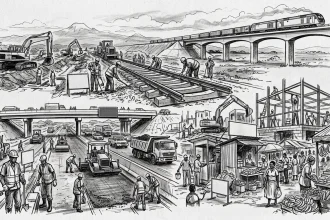
The larger argument is about what Africa should look like as its population and infrastructure needs expand. By 2050, Mr Ruto noted, Africa will have a population approaching 2.5 billion, requiring enormous investment in power, transport and industry.
The continent cannot finance that transformation through a series of isolated exceptional transactions. It needs a financial system in which investment in African productive assets becomes normal.
That brings the argument back to the teacher in Eldoret. After two decades of contributing to a pension fund, her savings represent precisely the kind of domestic capital Africa says it needs. Yet under the current structure, that money is far more likely to finance government securities than a power plant, road, water project or other productive asset.
The challenge, therefore, is not simply convincing her pension fund to take more risk. It is creating a financial architecture in which investing in the infrastructure around her does not automatically look like the adventurous choice.
That is the deeper question raised by Kenya in New York: Can Africa build rules that allow African savings to finance Africa’s future? If it can, the debate over development finance may have to move from how much money Africa can attract to how effectively it can put its own money to work.