





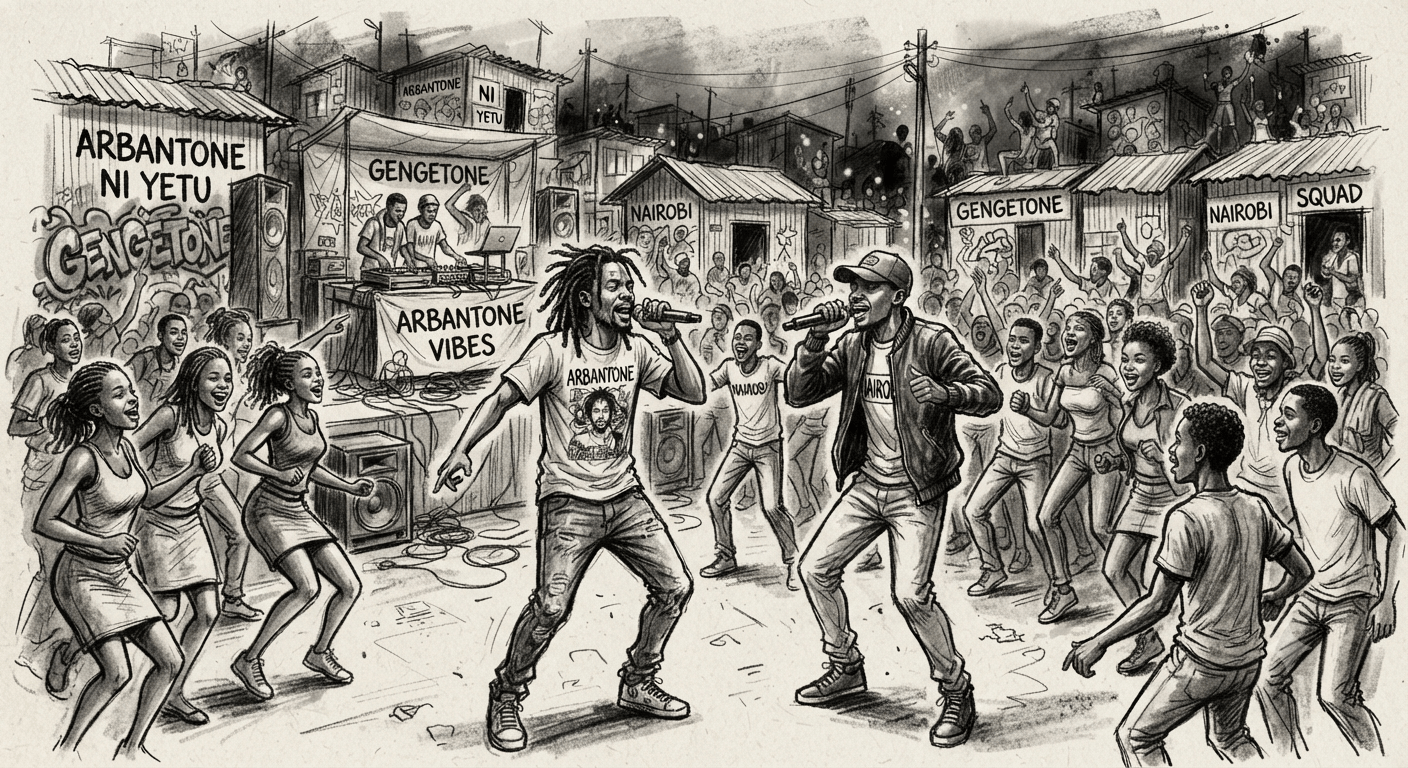
There is a version of Kenyan musical sound history that runs in a straight line: Genge to Gengetone, Gengetone to Arbantone, each generation inheriting the street energy of the last and filing off the rougher edges.
It is a useful shorthand and, like most shorthands, it leaves the most interesting story out. In 2026, Nairobi is not producing one sound. It is producing several, simultaneously, each with its own infrastructure, its own audience, and its own theory of how a Kenyan artist survives financially.
What they share is a city that is, by any measure, one of the most creatively productive on the continent right now.
Gengetone was supposed to be dead. The genre that Ethic Entertainment detonated onto the scene in 2019, raw, Sheng-dense, sexually explicit and completely unbothered, burned bright for roughly three years before the combined weight of its own controversy, the pandemic, and audience fatigue extinguished the flame.
The genre’s most enduring quality turned out to be its alumni. Mejja, who rode the Gengetone wave without ever being fully captured by it, released his Mtoto wa Khadija album in early 2026, collaborating with Toxic Lyrikali on “Kale Ka Uoga”, a pairing that felt less like a genre exercise and more like two artists who understand exactly what they are doing.
His signature flow and witty lyrics remain as precise as ever. Ethic themselves have returned with new material.
That a genre declared finished is still producing significant work tells you a lot about the difference between a sound dying and a sound evolving.
Arbantone: The Correction
The first massive milestone for Arbantone came in late 2023, when producer Soundkraft assembled Avengers, Tipsy Gee, Gody Tennor and Kappy for “TikToker,” a track that amassed staggering view counts and announced a new direction for Kenyan urban music.
The genre’s defining move was a conscious rebranding: where Gengetone had been gritty and divisive enough to attract radio bans and advertiser discomfort, Arbantone positioned itself as a cleaner, more commercially viable successor.
The sonic architecture is built on nostalgia. A defining feature is the use of beats and melodies from older Kenyan and Jamaican songs, the so- called TBT, or Throwback Thursday, hits, layered with new dance-ready rhythms that create a blend of old and new, with pull across both Gen Z listeners and older millennials who grew up with the original material.
Artists like Lil Maina, YBW Smith, Maandy, Kappy and Gody Tennor have built substantial audiences on TikTok and YouTube through this formula, with viral dance challenges doing much of the distribution work that radio once handled.
The question the industry is still working through is whether Arbantone has fixed the structural problem that killed Gengetone. There is a noticeable absence of management, business infrastructure, and professional support systems surrounding artists.
Producer Motif Di Don has pointed out that the lessons learned from Gengetone’s decline have been acknowledged. The current strategy is to transform Arbantone from merely a genre into a culture complete with its own visual identity and brand. While Gengetone had its moment, Arbantone’s structural viability is still under evaluation.
The Alternative Lane
Running parallel to the Gengetone-Arbantone talk is an alternative scene that has been developing, now producing some of the most internationally recognised Kenyan music in recent years.
Njerae, affectionately known as Kenya’s Lover Girl, has emerged as one of the most emotionally resonant voices of her generation. She blends Afro- Indie, R&B, and neo-soul into a sound that feels intimate yet accessible.
Her breakout track “Aki Sioni” from 2022 became Kenya’s most-streamed song of 2025, highlighting the lag between release and recognition that characterises how alternative audiences evolve, slowly and then all at once.
Bien, who gained mainstream recognition through his work with Sauti Sol, returned in 2026 with solo material that confidently explores the Afro-soul genre, an area that few Kenyan artists inhabit.
Xenia Manasseh, Blinky Bill, and Muthoni Drummer Queen continue to strengthen a scene that has always been marked by greater artistic ambition than commercial infrastructure, supported by live platforms such as Blankets & Wine and Café Ngoma.
Kenyan-Australian artist Elsy Wameyo has crafted a sound that merges hip-hop, soul, and traditional African elements. Her 2025 EP features collaborations with Khaligraph Jones, placing her within an East African hip-hop lineage while asserting her distinct voice.
The alternative scene’s connection with the diaspora, artists who travel between Nairobi and cities like London, Adelaide, or New York, contributes to its diversity and international appeal.
The Algorithm as A&R
Underlying both scenes is an infrastructural shift that is reshaping the economics of Kenyan music more significantly than any genre cycle. TikTok and YouTube have functionally replaced radio as the primary discovery mechanism, which means the gatekeeping that once belonged to programme controllers now belongs to an algorithm that rewards short, hook-forward, dance-challenge-ready content.
Arbantone was practically designed for this environment. The genre’s fast-paced rhythms, Sheng lyrical delivery, and lip-sync-friendly hooks made it a native fit for TikTok, and its biggest hits were built on viral challenges rather than playlist placement.
The alternative scene has adapted differently, leaning into YouTube performance videos, curated streaming playlists, and the kind of slow-burn word-of-mouth that algorithms eventually reward once enough engagement accumulates.
Toxic Lyrikali’s rise is the most instructive case study in the current moment: his breakout “Chinje” (2024) clocked over 11 million YouTube views, propelled by word of mouth rather than marketing muscle, and by late 2025, he ranked as Kenya’s most-streamed artist for several consecutive months.
What is clear in 2026 is that the Kenyan music industry is no longer waiting for a Nigerian or Tanzanian wave to clear before it gets its share of the room.
The sounds emanating from Nairobi, from Eastlands riddims to alt-soul recorded in home studios off Ngong Road, are growing more confident that the room is theirs to occupy. The artists know it. The algorithm is slowly agreeing.