


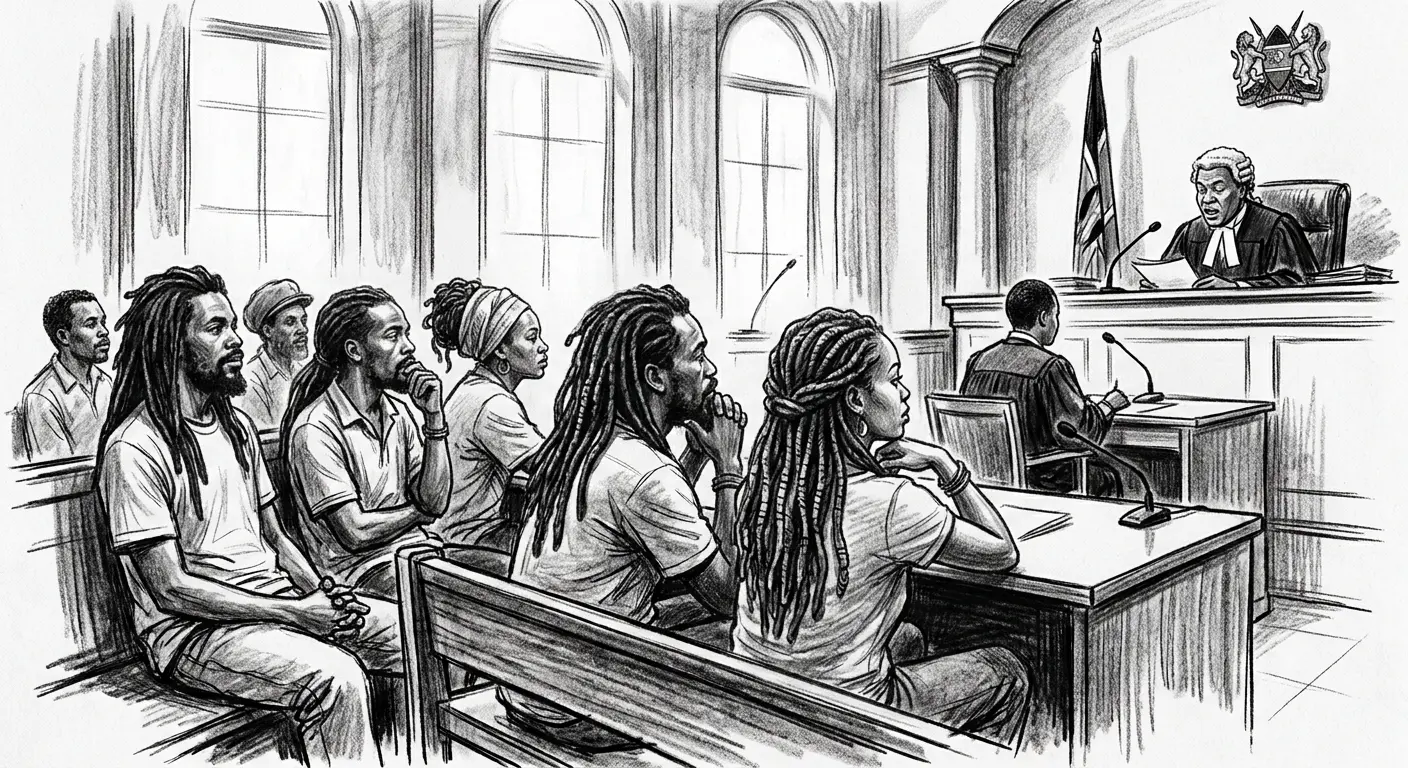
When Justice Bahati Mwamuye sat down to write his ruling on the Rastafari Society of Kenya’s bid to legalise cannabis for religious use, he reached for an unlikely legal authority: a party anthem by a Kenyan band called Just Imagine Africa.
The song, titled “Bangi”, a Swahili word for marijuana, opens with lyrics that might seem more at home in a nightclub than a courtroom:
“Ukiamka kwenda Church, mi huamka kuvuta bangi; Mi huvuta bangi ndio ni deal na mashetani…”
(When you wake up to go to church, I wake up to smoke cannabis; I smoke cannabis to deal with devils.)
But for Justice Mwamuye, these words were not just catchy lines; they were cultural evidence of a profound disconnect between Kenya’s cannabis laws and the country’s social reality.
Cultural Context Of The Song
Just Imagine Africa is a Kenyan Afro-fusion, pop and reggae band fronted by the late Michael Mugo, who served as lead vocalist, songwriter and rhythm guitarist.
The group, which also includes members Daniel Mbithi, Dominic Juma, Wambui Ng’ang’a, Arlon Mwangi, Brian Joseph, Joel Djowa and Marlon Aduvaga, had already built a following with hits like Mumbi, Madame Wa Kenya and Like Heaven. Then came Bangi.
Released in early 2020, the track was described as a “comical and creative tune” that openly discussed marijuana use and the need to legalise it. Mugo conveyed that cannabis helped him deal with the daily challenges of an average Kenyan youth, and his message resonated widely. The music video amassed over 800,000 views on YouTube.
The song marked a significant milestone as one of the first mainstream Kenyan tracks to glorify marijuana, sparking active discussions about why its use remained illegal. Tragically, Mugo passed away in September 2023.
The Rastafari Society of Kenya filed its petition in 2021, seeking a constitutional exemption allowing members to cultivate, possess and use cannabis privately as a religious sacrament.
They argued that cannabis was a “holy herb” used to achieve “cosmic consciousness” and a connection with “JAH” – and that the ban infringed on their constitutional rights to freedom of religion.
Justice Mwamuye, when delivering his judgment on July 15, 2026, described the band’s work as part of a “veritable ocean of cultural expressions” that positions cannabis as a means for spiritual peace and enlightenment.
The judge also cited Peter Tosh’s 1976 anthem “Legalise it” using the lyrics, “Singers smoke it; And players of instruments too… Doctors smoke it; Nurses smoke it; Judges smoke it; Even Lawyers too”.
The judge observed that Kenya is “awash with cultural expressions”** of cannabis use, from hit songs to imagery and text on matatus (ngangyas).
He noted that the “shock effect” of being associated with cannabis had diminished, with many prominent Kenyan personalities openly admitting to past or present use.
He also pointed to the open sale of cannabis-derived products, including “weed cookies”, in mainstream shops and supermarkets as evidence of the drug’s normalisation.
Reasons For The Court’s Dismissal
Despite this cultural acknowledgement, Justice Mwamuye ultimately dismissed the petition. He gave several reasons:
The petitioners had not pursued licensing mechanisms already available under Kenya’s Narcotic Drugs and Psychotropic Substances (Control) Act before turning to the courts.
He pointed out that witness testimony was inconsistent. Some adherents acknowledged that Rastafarians could worship without cannabis and that some members never used it at all.
The judge concluded that cannabis appeared to be a “preferred mode of worship” rather than a mandatory doctrinal requirement.
The petitioners had failed to provide a concrete plan for how a religious exemption would be regulated.
Any limitation on religious freedom was reasonable and justifiable under Article 24 of the Constitution to protect public health and safety, with the court citing evidence from NACADA on the risks of cannabis, including dependency, cognitive impairment and mental health disorders.
But the judge was careful to clarify that his remarks were not an endorsement of legalisation.
“This is not to excuse cannabis use or to argue that it should be legalised merely because ‘the war is lost,’” he said.
Instead, he posed a broader policy question: “Do we now need to have a national social conversation, outside of courts and legislative houses, on what do we do with this phenomenon in light of what it has become in our society?”